Mr. Nelson Rockefeller
In Office: December 19, 1974 – January 20, 1977
Political Party: Republican
Home State: Maine
Lifespan: 1908–1979
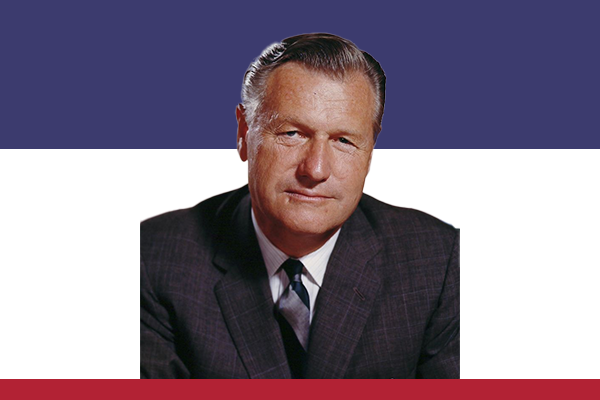
Nelson Rockefeller (1908–1979) was the 41st Vice President of the United States, serving under President Gerald R. Ford from 1974 to 1977. A member of the wealthy and powerful Rockefeller family, he played a major role in mid-20th-century American politics as a moderate-to-liberal Republican. In addition to his vice presidency, he served four terms as governor of New York and held multiple federal positions. His long public career reflected his belief in using government to solve social problems, promote economic growth, and expand cultural access.
Early Life and Background
Nelson Aldrich Rockefeller was born on July 8, 1908, in Bar Harbor, Maine, into one of the wealthiest families in American history. His grandfather, John D. Rockefeller Sr., founded Standard Oil and became the first American billionaire. Nelson’s father, John D. Rockefeller Jr., was a major philanthropist. Educated at Dartmouth College, Nelson graduated in 1930 and immediately became involved in both business and public service. Although he came from a family of immense privilege, he saw himself as a reformer and a problem-solver, determined to use his resources and influence for public benefit.
Early Government Roles
During the administration of President Franklin D. Roosevelt, a Democrat, Rockefeller served in several roles related to Latin American affairs, including Coordinator of Inter-American Affairs during World War II. He was known for his energy, organizational skill, and internationalism. Later, under President Dwight D. Eisenhower, he served as Under Secretary of Health, Education, and Welfare and as a key adviser on Cold War strategy and foreign policy. These experiences shaped his views on government activism and the role of the U.S. in global affairs. He became a leading figure in what was then the moderate or liberal wing of the Republican Party—supportive of civil rights, international cooperation, and social welfare programs.
Governor of New York (1959–1973)
Rockefeller was elected Governor of New York in 1958 and served four terms, holding the office for 15 years—longer than any of his predecessors. As governor, he pursued an ambitious agenda:
- He expanded the state’s university system (SUNY) dramatically.
- He invested in infrastructure, including highways, public housing, and mass transit.
- He supported civil rights and anti-poverty programs.
- He advocated for environmental conservation and urban development.
Despite these accomplishments, his policies led to massive increases in state spending and debt, which critics called reckless. Nevertheless, his supporters saw him as a forward-looking leader who used the government to improve people’s lives.
Presidential Ambitions
Rockefeller sought the Republican presidential nomination three times—in 1960, 1964, and 1968—but never secured it. His moderate stances, particularly on civil rights and social issues, alienated many conservatives in the party. In 1964, his divorce and remarriage also drew public scrutiny. His most serious run came in 1964 when he challenged conservative Arizona Senator Barry Goldwater. Despite early momentum, Rockefeller lost in the primaries, and Goldwater won the nomination. This campaign marked a major turning point in the Republican Party, signaling the rise of its conservative wing.
Vice Presidency (1974–1977)
In the aftermath of the Watergate scandal, President Richard Nixon resigned in 1974. His successor, Gerald Ford, nominated Rockefeller to serve as Vice President under the 25th Amendment. Congress confirmed him, and he took office in December 1974. Rockefeller brought significant experience to the vice presidency, but his relationship with Ford was sometimes strained. Ford, seeking to unite the party ahead of the 1976 election, eventually chose conservative Senator Bob Dole as his running mate, sidelining Rockefeller from the ticket. Despite the short duration of his term, Rockefeller remained active—particularly in domestic policy and national security discussions—and helped manage transitions and crises during Ford’s presidency.
Later Life and Legacy
After leaving office in 1977, Rockefeller returned to private life, continuing his involvement in philanthropy and the arts. He was a passionate advocate for public access to art and played a key role in expanding institutions like the Museum of Modern Art in New York City. Nelson Rockefeller died of a heart attack on January 26, 1979, at the age of 70. His sudden death sparked some public speculation due to unclear circumstances, but the cause was confirmed as natural.
Legacy
Nelson Rockefeller remains one of the most influential moderate Republicans in American history. Though his presidential ambitions were never realized, his impact as governor, policymaker, and vice president left a lasting imprint on American politics. He symbolized a time when the Republican Party included a strong centrist tradition—pro-business, yet socially progressive and deeply invested in government-led solutions. While today’s political climate has shifted, Rockefeller’s legacy endures in his efforts to combine wealth, power, and a sense of public responsibility into a force for national progress.