Mr. Hubert Humphrey
In Office: January 20, 1965 – January 20, 1969
Political Party: Democratic
Home State: South Dakota
Lifespan: 1911–1978
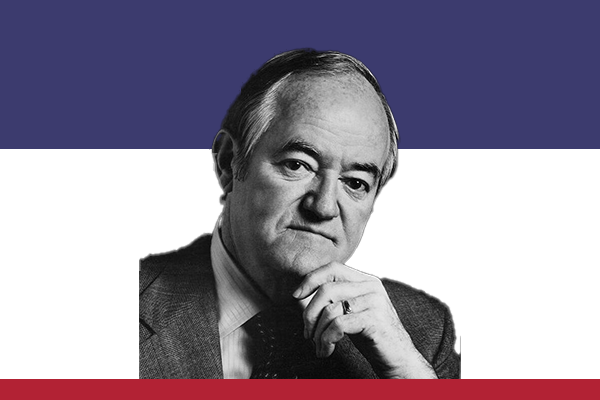
Early Life and Education
Born on May 27, 1911, in Wallace, South Dakota, Humphrey grew up in a small-town setting shaped by the Great Depression and populist politics. After earning his degree from the University of Minnesota, he went on to study at Louisiana State University, where he deepened his understanding of government and economics. Humphrey worked as a pharmacist in his father’s drugstore before entering public service, inspired by New Deal liberalism and a desire to help working-class Americans.
Political Career and Rise to National Prominence
Mayor of Minneapolis (1945–1948)
Humphrey’s political career began as Mayor of Minneapolis, where he modernized city government and combated police corruption and racial discrimination. His success at the local level propelled him onto the national stage.
U.S. Senator from Minnesota (1949–1964, 1971–1978)
First elected to the U.S. Senate in 1948, Humphrey quickly became a leading progressive voice, championing civil rights, labor rights, nuclear disarmament, and expanded social programs.
His defining moment came at the 1948 Democratic National Convention, where he delivered a fiery speech demanding a strong civil rights platform, declaring:
“The time has arrived in America for the Democratic Party to get out of the shadow of states’ rights and walk forthrightly into the bright sunshine of human rights.”
This speech helped realign the Democratic Party toward civil rights and laid the groundwork for the legislation passed in the 1960s.
Vice President of the United States (1965–1969)
Humphrey was elected Vice President in 1964 on the Democratic ticket with President Lyndon B. Johnson, following the assassination of John F. Kennedy. His tenure coincided with a period of sweeping domestic change and international turbulence.
Key Achievements and Responsibilities:
- Supported the Great Society: Humphrey worked closely with Johnson to pass landmark legislation, including the Civil Rights Act of 1964, the Voting Rights Act of 1965, and Medicare.
- Diplomatic Engagements: Represented the U.S. abroad to build international alliances during the Cold War.
- Voice of Moderation: Advocated for peaceful solutions during times of intense domestic unrest, including protests over the Vietnam War.
- Despite his accomplishments, Humphrey’s vice presidency was politically constrained by the increasingly unpopular Vietnam War. His loyalty to Johnson’s policies hurt his public image among antiwar Democrats.
- 1968 Presidential Campaign
After Johnson declined to seek re-election, Humphrey became the Democratic nominee for President in 1968. Running during a time of deep national division—marked by the Vietnam War, civil rights struggles, and the assassinations of Martin Luther King Jr. and Robert F. Kennedy—Humphrey struggled to unite the party. Although he narrowed the gap late in the race, he lost narrowly to Republican Richard Nixon in one of the most pivotal elections in U.S. history.
Return to the Senate and Final Years
Humphrey returned to the Senate in 1971, where he continued to champion progressive causes until his death in 1978. Even in his final years, while battling cancer, he remained active in politics, admired across party lines for his optimism and commitment to justice.
Legacy and Impact
Hubert Humphrey is remembered as:
- A civil rights pioneer who transformed the Democratic Party’s stance on racial equality
- An architect of social welfare programs that reshaped American life
- A respected statesman whose idealism and moral compass influenced generations of leaders
- His unwavering belief in the potential of government to improve people’s lives and his ability to inspire hope during turbulent times remain central to his enduring legacy.