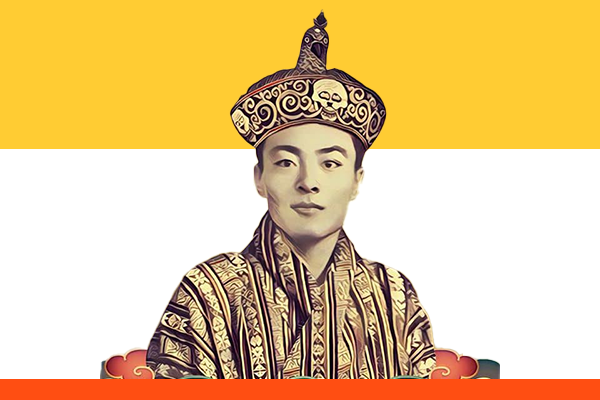
Mr. Jigme Dorji Wangchuck
Coronation: 27 October 1952
Reign: 30 March 1952 – 21 July 1972
Home State: Trongsa, Bhutan
Lifespan: 2/05/1928 – 21/07/1972
Early Life and Education
Jigme Dorji Wangchuck was born on May 2, 1929, at Thruepang Palace in Trongsa, Bhutan. He was the only son of King Jigme Wangchuck and Queen Ashi Phuntsho Choden. From a young age, he was trained for leadership. He received both traditional monastic education and modern schooling, later studying in India and the United Kingdom. These diverse experiences helped shape his progressive outlook and future vision for Bhutan.
Ascension to the Throne
At the age of 23, Jigme Dorji Wangchuck became the third Druk Gyalpo (King) of Bhutan in 1952, following the death of his father. His accession marked the beginning of a transformative period in Bhutanese history. Determined to modernize Bhutan, he introduced widespread reforms to strengthen governance, improve living standards, and open the country to the international community.
Political and Legal Reforms
One of his most significant achievements was the establishment of the National Assembly (Tshogdu) in 1953. This created a platform for the people to participate in governance and laid the foundation for democratic evolution. He also formed the Royal Advisory Council and the Council of Ministers, promoting decentralization and shared leadership.
King Jigme Dorji Wangchuck introduced the Thrimzhung Chenmo, a national legal code that standardized laws across the kingdom. These reforms ensured justice and fairness while reducing the power of local feudal lords, helping to unify and stabilize the nation.
Socio-Economic and Educational Progress
The king launched Bhutan’s first Five-Year Plan in 1961, initiating modern economic planning. Under his guidance, Bhutan saw rapid progress in education, healthcare, and transportation. Schools, hospitals, and roads were developed, providing new opportunities and improving quality of life.
He also carried out land reforms, distributed land to the landless, and abolished serfdom. These social reforms empowered rural populations and promoted equity throughout Bhutanese society.
Foreign Policy and International Relations
King Jigme Dorji Wangchuck pursued a carefully balanced foreign policy. He strengthened relations with India, Bhutan’s closest ally, and began establishing diplomatic ties with other nations. His efforts culminated in Bhutan joining the United Nations in 1971, a milestone that affirmed its sovereignty and global identity.
Cultural and Environmental Stewardship
While modernizing the nation, the king remained deeply committed to Bhutanese traditions. He emphasized the preservation of Bhutan’s cultural heritage, including language, national dress, and architecture. His development policies were also mindful of the environment, setting the stage for Bhutan’s future reputation as a leader in ecological conservation.
Death and Legacy
King Jigme Dorji Wangchuck died unexpectedly on July 21, 1972, in Nairobi, Kenya, while receiving medical treatment. He was only 43. Despite his short life, he transformed Bhutan from a medieval society into a modern state with democratic foundations.
Conclusion
King Jigme Dorji Wangchuck is celebrated as the “Father of Modern Bhutan.” His visionary leadership, bold reforms, and deep sense of national identity shaped Bhutan’s development in profound ways. His legacy continues to inspire the nation’s leaders and citizens as they build on the foundations he laid.