Mr. Henry A. Wallace
In Office: January 20, 1941 – January 20, 1945
Political Party: Democratic
Home State: Orient
Lifespan: 1888–1965
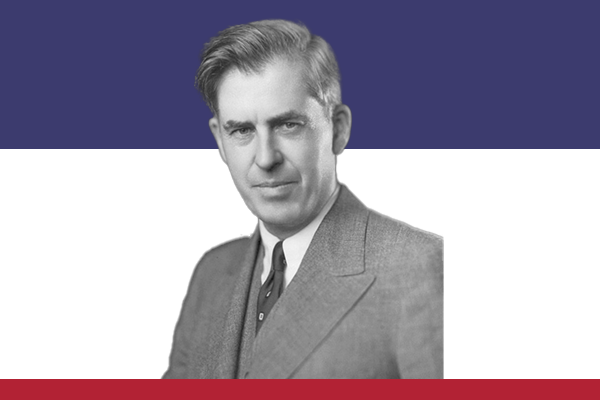
Early Life and Education
Born on October 7, 1888, in Orient, Iowa, Henry A. Wallace was raised in a family deeply involved in agricultural innovation. His father, Henry C. Wallace, served as U.S. Secretary of Agriculture, and his grandfather founded Wallace’s Farmer, a leading agricultural journal. Henry graduated from Iowa State College with a degree in animal husbandry and quickly made his mark in scientific agriculture and genetics. Wallace developed hybrid corn strains, revolutionizing American farming and dramatically increasing yields—pioneering a new era in agricultural science.
Secretary of Agriculture (1933–1940)
Wallace’s groundbreaking work in farming brought him to national attention, and in 1933, President Roosevelt appointed him Secretary of Agriculture during the height of the Great Depression. He played a crucial role in implementing New Deal policies, helping stabilize crop prices, provide relief to struggling farmers, and modernize American agriculture.
Key Contributions:
- Implemented the Agricultural Adjustment Act (AAA)
- Advocated for soil conservation and rural electrification
- Promoted scientific farming and government intervention to stabilize food production
- Wallace’s innovative approach made him one of the most effective agriculture secretaries in U.S. history.
Vice President of the United States (1941–1945)
In 1940, FDR chose Wallace as his running mate for his unprecedented third term. Serving as Vice President during World War II, Wallace was known for his progressive ideals, anti-fascist stance, and deep commitment to social equality.
As Vice President, Wallace:
- Chaired the Board of Economic Warfare, coordinating war production and resource distribution
- Advocated for civil rights, labor rights, and economic justice
- Delivered the famous “Century of the Common Man” speech, promoting global democracy and peace
- Despite his intellectual influence and popularity with progressives, Wallace’s outspoken views and clashes with party conservatives led to his replacement on the 1944 ticket by Harry S. Truman.
Later Political Career
After he left the vice presidency, Wallace briefly served as Secretary of Commerce from 1945 to 1946. However, he openly criticized emerging Cold War policies and strongly advocated for cooperation with the Soviet Union, which led President Truman to dismiss him from the administration. In 1948, Wallace ran for president as the Progressive Party candidate. He campaigned for civil rights, universal healthcare, peaceful coexistence with the USSR, and an end to Jim Crow segregation. Although more than a million Americans voted for him, Cold War tensions and accusations of Communist sympathies ultimately derailed his campaign.
Personal Life and Beliefs
Henry Wallace lived as a deeply spiritual man who embraced mysticism, theosophy, and progressive Christianity. He strongly believed that science, education, and international cooperation could uplift humanity. Wallace married Ilo Browne, and together they raised three children. He remained active in publishing and agriculture throughout his later years. When he died on November 18, 1965, he left behind a complex legacy marked by reform, idealism, and unwavering advocacy for the common man.