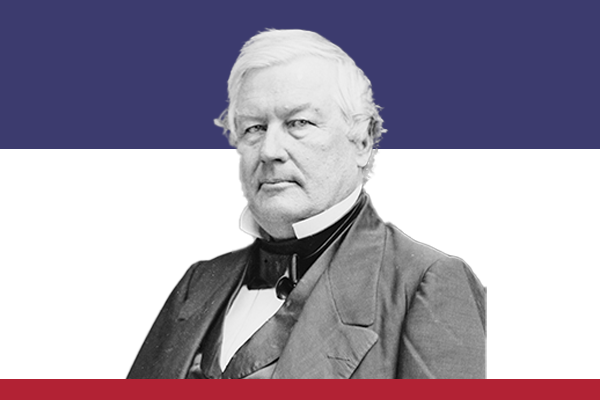
Mr. Millard Fillmore
In Office: March 4, 1849 – July 9, 1850
Political Party: Whig
Home State: New York
Lifespan: 1800–1874
Early Life and Education
Millard Fillmore was born on January 7, 1800, in a log cabin in Cayuga County, New York. Raised in poverty, he educated himself and apprenticed as a clothmaker before choosing to pursue law. He gained admission to the bar in 1823 and quickly entered public life. His early years reflected a deep commitment to hard work, education, and public service.
Political Rise and Congressional Service
Fillmore began his political career with the Anti-Masonic Party and later joined the Whig Party. He served in the New York State Assembly and won election to the U.S. House of Representatives in 1832. Over nearly a decade in Congress, he supported protective tariffs and promoted economic modernization. He also helped establish the Library of Congress and consistently advocated for internal improvements and fiscal responsibility.
Vice Presidency under Zachary Taylor (1849–1850)
In 1848, Fillmore won election as Vice President of the United States alongside President Zachary Taylor, a popular national war hero. While Taylor strongly opposed the expansion of slavery into new territories and represented Southern interests, Fillmore offered a moderate Northern balance to the ticket.
As Vice President, Fillmore presided over the U.S. Senate—his main constitutional duty. He earned a reputation for fairness, deep procedural knowledge, and his ability to maintain order in the chamber. During his time in office, the nation faced rising tensions over slavery. Although Taylor rarely sought Fillmore’s input on major policy matters, Fillmore remained aware of the growing sectional divide. His vice presidency came to an abrupt end when President Taylor died suddenly on July 9, 1850. According to the Constitution, Fillmore assumed the presidency.
Presidency (1850–1853)
As President, Fillmore played a central role in enacting the Compromise of 1850, a legislative effort to ease the tensions between Northern and Southern states. He personally signed all parts of the compromise into law, including the controversial Fugitive Slave Act. While the compromise delayed the Civil War, the enforcement of the Fugitive Slave Act cost him significant support in the North.
Fillmore also supported U.S. foreign policy expansion. He laid the groundwork for opening trade with Japan by backing Commodore Perry’s mission. Additionally, he modernized the White House and promoted national infrastructure development.
Later Life and Political Decline
After leaving office in 1853, Fillmore remained politically active. In 1856, he ran unsuccessfully for president as the candidate of the Know Nothing Party, a group that promoted nativist and anti-immigration policies. His campaign failed to gain broad support. In his later years, Fillmore stayed involved in civic life in Buffalo, New York. He helped establish the University at Buffalo and served as its first chancellor, dedicating himself to education and local development until his death.