Mr. Akram al-Hawrani
In Office: 7 March 1958 – 19 September 1960
Political Party: Arab Socialist Ba’ath Party
Home State: Hama
Lifespan: 1912–1996
Country: Egypt
Image credits available here.
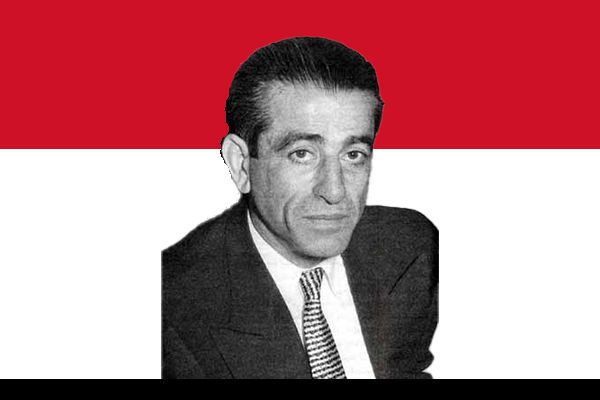
Early Life and Education
Akram al-Hawrani was born in 1911 in Hama, Syria, into a respected family with strong social and political ties. He grew up witnessing the struggles of ordinary Syrians under colonial rule and the economic hardships of peasants. These early experiences shaped his views on justice, equality, and reform.
He pursued education in law at Damascus University. During his student years, he actively engaged in political movements and advocated for social justice. His early exposure to activism helped him develop strong leadership qualities and a commitment to change.
Entry into Politics
Al-Hourani entered politics in the 1930s, determined to represent the interests of the working class and peasants. He founded a political base in Hama, where he addressed the grievances of farmers and challenged the dominance of large landowners. He established himself as a powerful orator and organizer. His ability to mobilize the masses gave him wide popularity, especially among rural communities. By demanding land reforms and social equity, he emerged as one of Syria’s most influential populist leaders.
Role in Syrian Political Life
In the 1940s and 1950s, Akram al-Hourani became a central figure in Syrian politics. He joined the Arab Socialist Movement and merged it later with the Ba’ath Party, which sought to unite Arab nationalism with socialism. This alliance strengthened his influence and provided a platform for his vision of an egalitarian society.
He opposed foreign domination and criticized corruption within the government. His political activities often challenged Syria’s elite, making him both admired and controversial. Despite opposition, he gained wide support from students, farmers, and workers who believed in his reforms.
Vice Presidency and Union with Egypt
In 1958, Syria and Egypt formed the United Arab Republic (UAR), a bold experiment in Arab unity led by Egyptian President Gamal Abdel Nasser. Akram al-Hourani served as Vice President of the union, representing the Syrian side in this political merger.
As Vice President, he worked to integrate Syria into the new republic. He promoted socialist reforms, land redistribution, and measures to reduce the gap between the rich and poor. His leadership gave peasants and workers a stronger voice in governance.
However, differences soon emerged between Syrian and Egyptian leaders. Many Syrians, including al-Hawrani, felt that Egypt dominated the union. Disillusioned, he resigned from his position in 1959, criticizing Nasser’s authoritarian approach and centralization of power.
Advocacy for Social and Agrarian Reform
Al-Hourani became most famous for his agrarian reform policies. He fought to end feudal practices and redistribute land from wealthy landowners to poor peasants. By pushing these reforms, he sought to reduce inequality and empower rural communities.
His policies transformed Syrian society by breaking the grip of large landlords and creating opportunities for small farmers. Although controversial, these reforms reshaped Syria’s economic and social structure, making him one of the most influential reformists of his time.
Later Years and Legacy
After resigning from the UAR government, al-Hourani continued to play a role in Syrian politics. However, his influence declined as the Ba’ath Party underwent internal divisions and shifts in leadership. He eventually distanced himself from active politics but remained a symbolic figure of reform and justice. Akram al-Hawrani passed away in 1996, leaving behind a complex legacy. Supporters remembered him as a revolutionary who championed the poor and stood against tyranny, while critics debated his methods and political choices.
Conclusion
Vice President Akram al-Hawrani played a pivotal role in shaping modern Syria. Through his dedication to socialism, agrarian reform, and Arab unity, he gave a political voice to marginalized groups. His leadership during the United Arab Republic and his tireless fight for equality secured him a lasting place in Syrian history.