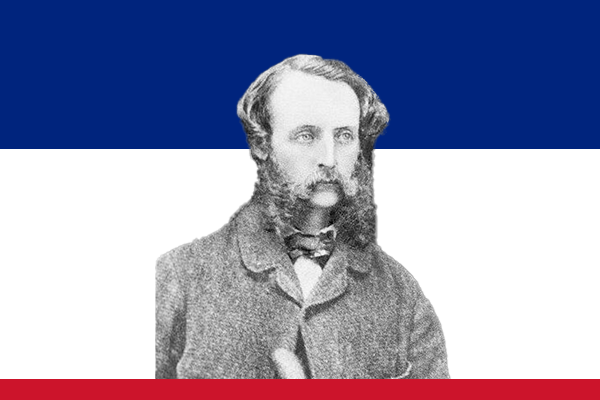
Mr. Frederick Weld
In Office: 24 November 1864 – 16 October 1865
Political party: Independent
Home State: Bridport
Lifespan: 1823–1891
Country: New Zealand
Image credits available here.
Early Life and Background
Frederick Aloysius Weld was born on 9 May 1823 in Chideock, Dorset, England, into a Catholic family of landed gentry. His upbringing in a devout household instilled strong moral values that later shaped his political vision. Weld studied at Stonyhurst College and later at the University of Fribourg in Switzerland. Instead of staying in England, he migrated to New Zealand in 1844, where he developed his skills as a pastoralist. His early years as a sheep farmer gave him a deep understanding of the colony’s land, economy, and challenges.
Entry into Politics
Weld entered politics in the 1850s when the colony began to establish self-government. He became a member of the House of Representatives in 1854, representing the Wairau electorate. His eloquence, knowledge of colonial issues, and ability to mediate disputes quickly made him a respected leader. Weld strongly supported the principle of responsible government, where elected representatives held real authority instead of colonial governors. His political ideology emphasized fairness, efficiency, and independence from undue imperial interference.
Premiership and Leadership Style
In November 1864, Weld became the 6th Prime Minister of New Zealand. His tenure, though brief, carried lasting influence. He took office during a turbulent period marked by the New Zealand Wars and financial strains. Weld believed New Zealand should rely less on British military intervention. He introduced the “self-reliance” policy, urging the colony to maintain its own defenses and reduce dependence on imperial troops. By doing so, he aimed to strengthen New Zealand’s sovereignty and financial stability.
Weld also championed infrastructural improvements and administrative reforms. He encouraged the development of roads and communication networks to unify distant settlements. His leadership style combined pragmatism with visionary thinking, as he sought to balance immediate security needs with long-term autonomy.
Challenges in Office
Despite his ambitious reforms, Weld faced strong opposition. Many settlers resisted the withdrawal of British troops, fearing vulnerability in conflicts with Māori communities. Financial constraints also limited his government’s ability to fully implement its policies. In addition, political rivalries within the parliament weakened his position. After less than a year in office, Weld resigned in October 1865, recognizing that his government lacked sufficient parliamentary support to continue.
Later Career and Contributions
Weld did not fade from public service after leaving the premiership. He continued to serve New Zealand as a politician and administrator before moving into significant roles across the British Empire. He worked as Governor of Western Australia (1869–1875), Governor of Tasmania (1875–1880), and later as Governor of the Straits Settlements (1880–1887). In these positions, Weld implemented reforms that improved governance, infrastructure, and relations between settlers and indigenous peoples. His reputation as a capable colonial administrator extended beyond New Zealand and left an international legacy.
Personal Life and Death
Frederick Weld married Filumena Mary Anne Lisle Phillipps, and together they raised a large family. His devout Catholic faith and commitment to service guided his personal and professional life. After years of colonial service, Weld retired in England, where he died on 20 July 1891 in Chideock.
Legacy
New Zealand remembers Frederick Weld as a reformist prime minister who shaped the country’s path toward greater independence. His “self-reliance” policy reflected a forward-looking vision of nationhood, even if it encountered resistance at the time. Historians recognize his tenure as short but significant, and his later roles across the empire highlight his broader impact as a statesman.