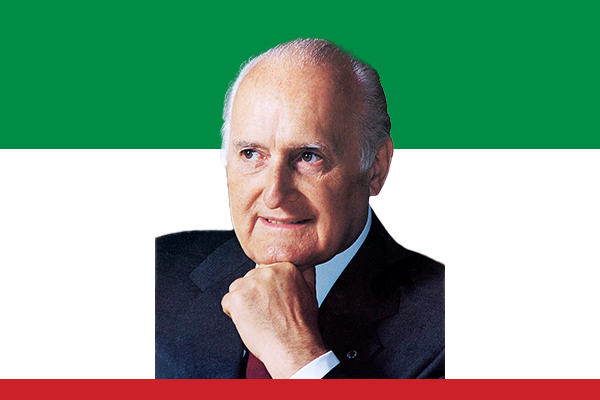
Early Life and Legal Career
Oscar Luigi Scalfaro was born on September 9, 1919, in Novara, Italy. He grew up in a deeply Catholic family that instilled strong moral values and a sense of civic duty. After completing his studies in law at the Catholic University of the Sacred Heart in Milan, Scalfaro began his career as a magistrate. He worked diligently in the legal field, where he gained a reputation for integrity and fairness. His early experiences in law shaped his later approach to governance and justice.
Entry into Politics
Scalfaro entered politics after World War II, joining the Christian Democracy (Democrazia Cristiana) party. In 1946, he won election to the Constituent Assembly, where he actively contributed to drafting Italy’s post-war Constitution. He fought for human rights, civil liberties, and democratic accountability. His political philosophy reflected his deep Catholic faith and a strong belief in ethical governance. Over the decades, Scalfaro served in several government positions, including Minister of the Interior and Minister of Education, where he worked to strengthen institutions and promote national unity.
Presidency During Political Upheaval
In 1992, Italy faced a period of severe political and social crisis. The “Mani Pulite” (Clean Hands) anti-corruption investigations exposed widespread corruption, shaking the foundations of Italy’s political system. During this turmoil, Parliament elected Oscar Luigi Scalfaro as President of the Republic. He accepted the presidency with humility and determination, vowing to protect the nation’s democratic values.
As President, Scalfaro acted decisively to preserve institutional stability. He refused to compromise with corruption and insisted on upholding the rule of law. He supported judicial independence and urged the public to maintain faith in democracy despite political scandals. His calm leadership reassured citizens and restored confidence in Italy’s democratic system.
Promoting Unity and Integrity
Throughout his presidency, Scalfaro actively promoted moral integrity, unity, and transparency in government. He frequently addressed the nation, calling for honesty, patriotism, and civic responsibility. He built bridges between political parties and encouraged dialogue instead of division. Scalfaro also emphasized Italy’s role in the European Union, advocating for closer integration and cooperation.
He took a firm stance against political manipulation and corruption. When faced with government instability, Scalfaro made balanced and lawful decisions that prioritized the nation’s stability over personal or party interests. His leadership earned him widespread respect from citizens across political lines.
Legacy and Influence
After his presidency ended in 1999, Scalfaro continued to serve as a moral voice in Italian politics. He spoke out on issues of justice, civil rights, and the Constitution, reminding Italians of their democratic responsibilities. His words carried authority and sincerity, shaped by a lifetime of public service.
Scalfaro’s influence extended beyond his political achievements. He symbolized integrity, decency, and devotion to the nation. His presidency reminded Italy that true leadership depends on honesty and courage, not power or privilege. Even after leaving office, he continued to defend democratic ideals until his death on January 29, 2012.
Conclusion
President Oscar Luigi Scalfaro remains a symbol of moral strength and principled leadership in Italy’s political history. He guided the country through one of its most turbulent periods with wisdom and dignity. By defending democratic values and the Constitution, he reinforced the foundations of the Italian Republic. His life and career continue to inspire future generations of leaders to uphold justice, transparency, and faith in democracy.