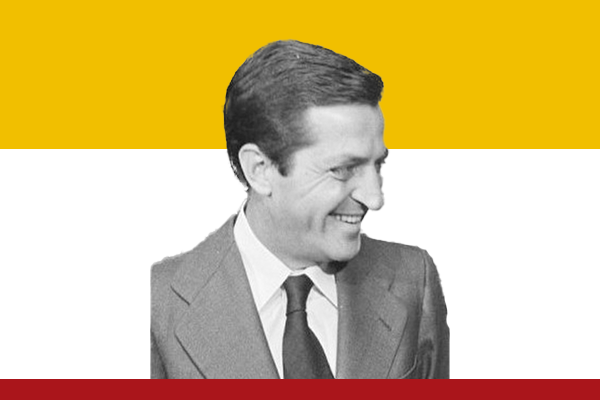
Early Life and Political Rise
Adolfo Suárez González was born on September 25, 1932, in Cebreros, Ávila, Spain. He grew up in a modest family and developed a strong sense of determination and discipline early in life. Suárez pursued his studies in law at the University of Salamanca, where he cultivated his interest in politics and governance. His education and communication skills helped him enter the administrative services during Francisco Franco’s regime, where he began to build valuable connections within Spain’s political system.
During the early years of his career, Suárez worked in the state broadcasting organization and later became Director-General of Spanish Radio and Television (RTVE). His efficiency and loyalty caught the attention of high-ranking officials, who promoted him to key government positions. By the time Franco’s regime neared its end, Suárez had already gained significant political experience and established himself as a skilled negotiator capable of balancing traditionalist and reformist viewpoints.
Becoming Prime Minister
In 1976, following Franco’s death and the appointment of King Juan Carlos I, Spain needed a leader who could guide the country through its fragile transition to democracy. The King chose Adolfo Suárez as Prime Minister, surprising many political observers who viewed him as a loyal supporter of the old regime. However, Suárez quickly dispelled doubts by showing courage and a deep commitment to democratic reform.
As Prime Minister, he took decisive action to dismantle the remnants of Franco’s authoritarian system. He legalized political parties, including the Spanish Socialist Workers’ Party (PSOE) and the Communist Party, which had long been banned. Suárez also introduced the Political Reform Act, which opened the path for free elections and a new democratic constitution. His leadership helped Spain avoid civil unrest and ensured a peaceful political transition that gained international admiration.
Leading Spain’s Democratic Transition
Adolfo Suárez led the Union of the Democratic Centre (UCD), a coalition that represented a broad spectrum of moderate political views. In 1977, under his leadership, Spain held its first free general elections in over forty years. His party won the majority, making him the first democratically elected Prime Minister of modern Spain.
Suárez’s government worked tirelessly to draft the 1978 Spanish Constitution, which guaranteed civil liberties, established parliamentary democracy, and recognized the autonomy of Spain’s regions. He built consensus among political groups that had once been deeply divided, demonstrating his ability to unite diverse factions in pursuit of a common goal. His calm, pragmatic style helped stabilize Spain during a time of social and political uncertainty.
Despite his achievements, Suárez faced significant challenges, including internal conflicts within his party, economic difficulties, and tensions from separatist movements. Nevertheless, he continued to defend democratic principles and the rule of law, even in the face of opposition from both the far right and far left.
Later Years and Legacy
In 1981, Suárez resigned from office, acknowledging that his leadership had become a source of division within the UCD. His resignation paved the way for a new government, but his influence on Spain’s democratic foundations remained unshakable. He later formed the Democratic and Social Centre (CDS), seeking to continue his political vision, though the new party never achieved the same level of success.
Suárez’s later years were marked by illness, yet his legacy as the architect of Spain’s democracy endured. King Juan Carlos I and the Spanish people honored him as a national hero who prioritized the country’s stability and freedom over personal ambition. He passed away on March 23, 2014, leaving behind an enduring example of leadership, integrity, and vision.
Conclusion
Prime Minister Adolfo Suárez González transformed Spain through determination and dialogue. By leading the nation’s peaceful transition from dictatorship to democracy, he redefined Spain’s political identity and strengthened its global reputation. His courage and belief in democratic ideals continue to inspire leaders and citizens alike, ensuring that his contribution to Spain’s history will never be forgotten.