Mr. João Figueiredo
In Office: 15 March 1979 – 15 March 1985
Political Party: National Renewal Alliance
Home State: Bento Gonçalves
Lifespan: 1918–1999
Country: Brazil
Image credits available here.
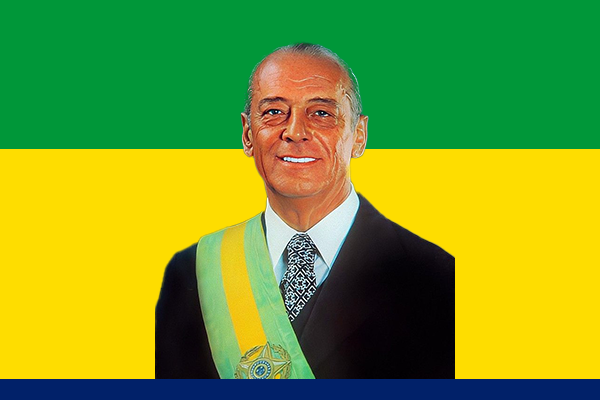
Early Life and Military Career
João Baptista de Oliveira Figueiredo was born on January 15, 1918, in Rio de Janeiro, Brazil. He pursued a military career early in life and graduated from the Military Academy of Agulhas Negras. Throughout his service, he gained a reputation for discipline, intelligence, and loyalty to Brazil’s armed forces. Figueiredo held several key military posts, including chief of the National Intelligence Service (SNI), where he played a central role in national security planning. His experience in intelligence and defense prepared him for political leadership during a critical period in Brazil’s history.
Rise to the Presidency
The military government selected Figueiredo to succeed President Ernesto Geisel in 1979. Geisel supported Figueiredo’s candidacy because he believed Figueiredo could continue the slow and controlled process of “abertura,” or political opening, that aimed to restore democracy. After being elected indirectly by the Electoral College, Figueiredo took office on March 15, 1979. He became the fifth and final military president of Brazil’s 21-year dictatorship.
Figueiredo accepted the challenge of transitioning Brazil toward democracy while maintaining the stability demanded by the military elite. He promised to “make this country a democracy” and expressed his desire to reconcile the government with the people. His presidency became a turning point in Brazil’s political history.
Promoting Political Liberalization
Figueiredo actively pursued policies that expanded political freedom. In 1979, he signed the Amnesty Law, which allowed exiled politicians and citizens who had opposed the dictatorship to return to Brazil. This decision encouraged political dialogue and reduced tensions between the military and civilians.
He also legalized political parties that had previously been banned, ending the two-party system established under military rule. By restoring a multiparty democracy, he allowed citizens to participate more freely in elections. Despite opposition from conservative military factions, Figueiredo continued to push for reform, believing that Brazil needed political modernization to move forward.
Managing Economic and Social Challenges
Figueiredo faced severe economic difficulties during his presidency. Inflation rose sharply, and Brazil’s foreign debt reached record levels due to global economic instability and the oil crises of the 1970s. The government implemented austerity measures and negotiated with international lenders to stabilize the economy. However, economic growth remained weak, and social dissatisfaction increased.
Figueiredo also confronted a surge of labor strikes, particularly from metalworkers and public employees demanding better wages. Instead of suppressing the protests with force, he often chose negotiation, understanding that violent repression could undermine the legitimacy of the democratic transition. His leadership during these turbulent years reflected his pragmatic approach and recognition of Brazil’s changing political landscape.
Transition to Civilian Rule
As Figueiredo’s term neared its end, public pressure for direct presidential elections intensified. The “Diretas Já” movement mobilized millions of Brazilians across the country, demanding the right to vote directly for the president. Although Congress rejected the proposed constitutional amendment for direct elections, the movement accelerated Brazil’s path toward democracy.
In 1985, Figueiredo oversaw the indirect election of Tancredo Neves, a civilian politician, marking the end of the military regime. Figueiredo peacefully transferred power, fulfilling his promise to restore democracy. His departure symbolized the conclusion of two decades of military rule and the beginning of a new democratic era.
Legacy and Later Life
After leaving office, Figueiredo retired from politics and lived quietly, avoiding public appearances. He remained proud of his role in Brazil’s democratic transition, once saying he preferred the “noise of democracy” to the “silence of dictatorship.” He passed away on December 24, 1999, in Rio de Janeiro.
Figueiredo’s presidency represented both the end of authoritarianism and the beginning of democratic hope for Brazil. His efforts to liberalize the political system and manage a peaceful transition earned him a lasting place in the nation’s modern history.
Conclusion
President João Figueiredo guided Brazil through one of its most critical turning points. By encouraging political openness, allowing exiles to return, and overseeing the transition to civilian government, he played a decisive role in shaping Brazil’s democratic future. His leadership closed the chapter on military rule and opened the door to a new era of freedom and civic participation.