Mr. Fernando Henrique Cardoso
In Office: 1 January 1995 – 1 January 2003
Political Party: Brazilian Social Democracy Party
Home State: Rio de Janeiro
Lifespan: born–1931
Country: Brazil
Image credits available here.
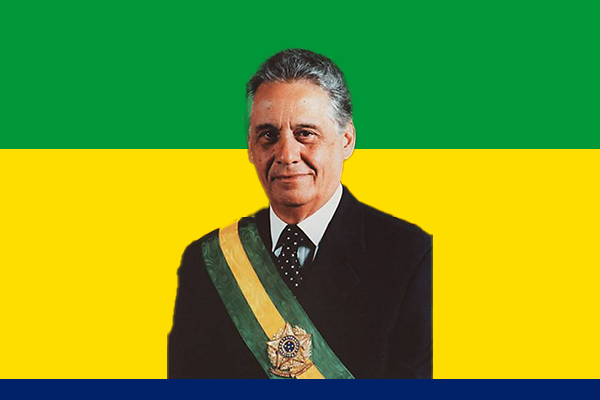
Early Life and Academic Foundations
Fernando Henrique Cardoso was born on June 18, 1931, in Rio de Janeiro, Brazil. He grew up in a family with strong military and intellectual traditions. Cardoso studied sociology at the University of São Paulo, where he later became a professor. His academic work focused on dependency theory, analyzing how developing countries could overcome economic inequality and political instability. His intellectual pursuits shaped his political vision and equipped him with a deep understanding of Brazil’s social and economic challenges.
During the years of military dictatorship, Cardoso stood firm against authoritarianism. He went into exile, teaching in Chile and France, where he continued to publish influential research. His academic contributions earned him international respect and laid the groundwork for his future political career.
Rise in Brazilian Politics
Cardoso returned to Brazil in the late 1970s as democracy began to re-emerge. He joined the Brazilian Democratic Movement (MDB) and later helped found the Brazilian Social Democracy Party (PSDB). He used his sociological insight to promote policies based on equality, development, and reform.
As a senator, Cardoso worked actively to strengthen Brazil’s democratic institutions. He supported constitutional reforms that aimed to expand civil liberties and social rights. His reputation as an honest and competent leader grew steadily. In the early 1990s, President Itamar Franco appointed him as Minister of Foreign Affairs and later as Minister of Finance.
Economic Reforms and the “Real Plan”
As Minister of Finance, Cardoso took decisive action to end Brazil’s chronic inflation. He introduced the Real Plan in 1994, a bold economic stabilization program that replaced the old currency with the real and curbed runaway inflation. His success in restoring economic confidence made him a national figure.
When Cardoso ran for the presidency later that year, Brazilians rewarded his leadership with a decisive victory. He assumed office on January 1, 1995. As president, Cardoso continued to implement economic reforms that promoted fiscal responsibility, privatization of inefficient state enterprises, and foreign investment. These actions helped integrate Brazil more deeply into the global economy and encouraged sustainable growth.
Governance and Social Policy
Cardoso’s leadership extended beyond economics. He launched social programs to reduce poverty and expand education. His administration promoted health care initiatives and infrastructure development to improve citizens’ living standards. He also emphasized environmental protection and sought to balance development with sustainability.
In foreign policy, Cardoso strengthened Brazil’s international presence. He built closer ties with other Latin American countries, enhanced cooperation with the United States and Europe, and positioned Brazil as a regional leader. His diplomatic approach combined pragmatism with a strong belief in democracy and human rights.
Legacy and Impact
Cardoso’s presidency lasted two terms, from 1995 to 2003. He left office with a legacy of stability and modernization. His policies transformed Brazil’s economy, reducing inflation, stabilizing growth, and attracting investment. By fostering transparency and accountability, he helped consolidate democratic governance in the country.
Although critics argued that social inequality persisted, Cardoso’s long-term reforms laid the foundation for future progress. His intellectual background gave his leadership a unique character — one that combined analytical thinking with practical action.
After leaving office, Cardoso continued to influence public life as an author, scholar, and advocate for democracy. He founded the Instituto Fernando Henrique Cardoso to promote dialogue and research on public policy and global affairs.
Conclusion
President Fernando Henrique Cardoso stands out as one of Brazil’s most influential leaders. His active leadership reshaped the nation’s economy and strengthened its democratic institutions. Through determination, vision, and intellect, he guided Brazil into a new era of stability and modernization, leaving an enduring mark on its political and economic landscape.