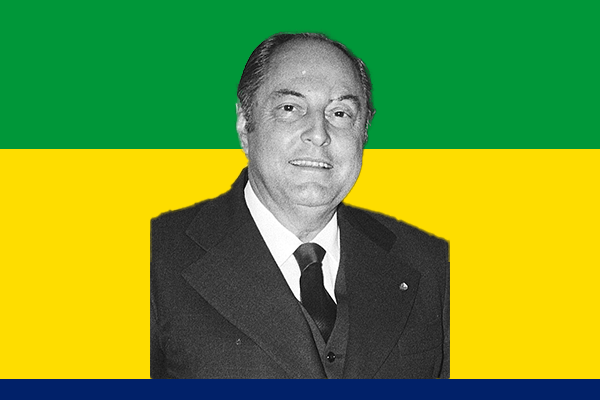
Mr. Aureliano Chaves
In Office: 15 March 1979 – 15 March 1985
Political Party: National Renewal Alliance
Home State: Três Pontas
Lifespan: 1929–2003
Country: Brazil
Image credits available here.
Early Life and Political Rise
Aureliano Chaves was born on January 13, 1929, in Três Pontas, Minas Gerais, Brazil. He grew up in a modest family and pursued his education in engineering, which equipped him with a disciplined and analytical mindset. He entered politics early, driven by a passion for progress and civic responsibility. His political career began in Minas Gerais, where he quickly gained respect for his administrative skill and balanced judgment.
As a member of the National Renewal Alliance Party (ARENA), Chaves demonstrated loyalty to public service and commitment to modernization. He served as a federal deputy and later became the governor of Minas Gerais. In that role, he focused on industrial growth, energy development, and public welfare programs that strengthened the state’s infrastructure. His success at the state level propelled him to the national stage, where he emerged as one of Brazil’s most capable political figures during a transformative era.
Leadership as Vice President
In 1979, Aureliano Chaves became Vice President under President João Figueiredo, during Brazil’s military regime. He played a crucial role in steering the nation toward political openness and democratic reform. When President Figueiredo faced health challenges, Chaves assumed the presidency temporarily, ensuring the continuity of government and maintaining national stability.
Chaves actively supported policies that encouraged economic liberalization and political participation. He collaborated with reform-minded leaders to ease restrictions on political activity and media freedom. His moderate stance and diplomatic nature made him a bridge between conservative military officials and the growing civilian movement calling for democracy.
Instead of waiting for others to act, Chaves personally encouraged discussions on constitutional reform and electoral transparency. He advocated for gradual but meaningful democratization, understanding that stability was essential for Brazil’s progress. His leadership style combined patience with firmness, allowing him to manage competing interests without losing sight of national unity.
Economic Vision and National Development
Aureliano Chaves recognized that Brazil’s economic future depended on modernization and diversification. He emphasized technological advancement, energy development, and efficient governance. As an engineer, he understood the importance of infrastructure, and he promoted the expansion of energy production through hydroelectric projects that benefited both urban and rural communities.
He pushed for policies that reduced inflation and encouraged industrial productivity. Chaves believed in balancing state involvement with private enterprise, supporting measures that empowered businesses while maintaining social responsibility. His initiatives contributed to economic resilience during a time of global uncertainty.
Commitment to Democracy and Public Service
After serving as Vice President, Chaves continued to influence Brazilian politics with his wisdom and experience. He joined the Brazilian Democratic Movement Party (PMDB), advocating for democratic consolidation and national unity. He ran for president in 1989, promoting reform and economic stability, though he did not win. His campaign reflected his lifelong dedication to integrity and public service.
Even outside elected office, Chaves worked to strengthen democratic institutions and inspire future generations of leaders. He valued dialogue, transparency, and respect for differing opinions. His character earned him the admiration of colleagues and citizens alike.
Legacy and Influence
Aureliano Chaves passed away on April 30, 2003, leaving behind a legacy of moderation, competence, and democratic commitment. His life symbolized the balance between order and freedom—an essential principle during Brazil’s transition to democracy.
Through his leadership, Chaves helped Brazil evolve from authoritarianism to democratic governance. He showed that calm and steady guidance could achieve reform without chaos. Today, his contributions remain an enduring example of responsible leadership and national service.
Conclusion
Aureliano Chaves exemplified the ideals of disciplined governance and democratic vision. As Vice President and acting President, he played a decisive role in shaping modern Brazil. His forward-thinking policies and moral strength guided the nation through one of its most delicate periods, making him a lasting figure in Brazilian history.