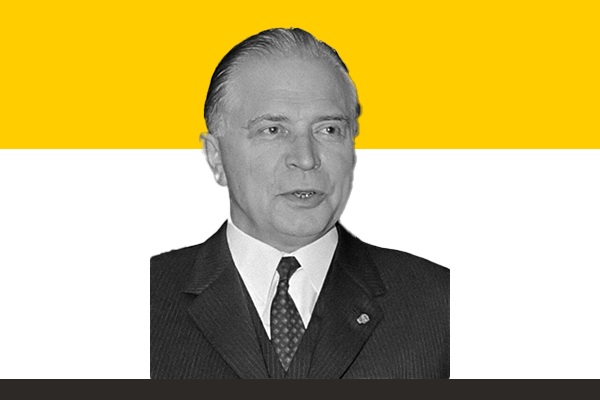
Early Life and Path to Politics
Gaston Eyskens began his life in Lier, Belgium, in 1905, and he pursued economics with deep interest. He completed his academic studies with distinction and later taught economics, which strengthened his understanding of fiscal systems. His expertise attracted political leaders, and he eventually entered public service. Eyskens embraced politics with the intent to stabilize Belgium’s economy and modernize the nation’s institutions. His strong academic background enabled him to analyze complex problems and craft practical solutions.
Rise to Political Prominence
Eyskens built his political foundation during the 1930s and 1940s, when he joined the Christian Social Party. He quickly gained influence because he combined economic knowledge with administrative skill. His party recognized his ability to manage financial issues, and they entrusted him with significant responsibilities. Eyskens accepted the challenges of public administration during a difficult period marked by war and instability.
As a minister, he took decisive steps to direct economic recovery after World War II. His reforms strengthened Belgium’s fiscal health and prepared him for higher office. His strong performance led the party to support his appointment as Prime Minister.
Leadership During Challenging Times
Gaston Eyskens served multiple terms as Prime Minister, and each term required him to address different national crises. He acted firmly when Belgium faced political tensions, economic pressures, and constitutional questions. His government confronted disputes over linguistic and cultural divisions, and he worked tirelessly to maintain national unity.
During his leadership, he introduced reforms that reshaped the Belgian state structure. He promoted decentralization to balance the interests of different communities, and he supported institutional changes that later formed the basis of Belgium’s federal system. Eyskens approached governance with a calm, analytical mindset, and he consistently aimed to protect the country’s long-term stability.
Handling Economic and Social Reforms
Eyskens used his economic training to design long-term development plans. He introduced policies that encouraged modernization and improved public services. His government supported infrastructure expansion, social welfare improvements, and economic diversification. He believed Belgium needed strong financial foundations, and he implemented measures to secure them.
One of his major achievements came during the “School Pact,” where he played a key role in resolving conflicts between state and religious schools. He encouraged compromise and restored educational stability. This act demonstrated his ability to bridge ideological divides.
The Congo Crisis and International Challenges
Eyskens confronted major international pressures during the Congo crisis in 1960. Belgium experienced political turmoil as the Congo moved toward independence. Eyskens worked with international partners to manage the challenges arising from decolonization. Although the crisis created uncertainty, he took diplomatic steps to reduce tensions and stabilize the situation.
His decisions during this period influenced Belgium’s global reputation and shaped its post-colonial policies. Even amid disagreement and controversy, he remained focused on long-term national interests.
Later Contributions and Legacy
In his later years, Eyskens continued to influence Belgian political development. He supported reforms that paved the way for Belgium’s gradual shift toward a federal system. His dedication to consensus building helped maintain political balance during periods of unrest.
Eyskens left a legacy of intellectual leadership and practical governance. He demonstrated how strong economic knowledge and steady decision-making can guide a nation through crises. Belgians remember him as a leader who modernized institutions, strengthened economic discipline, and steered the nation through difficult transitions.
Conclusion
Prime Minister Gaston Eyskens shaped Belgium with thoughtful reforms and decisive action. He handled economic challenges, political tensions, and international crises with expertise and determination. His leadership left a long-lasting imprint on Belgian society, and he remains a central figure in the nation’s modern political history.