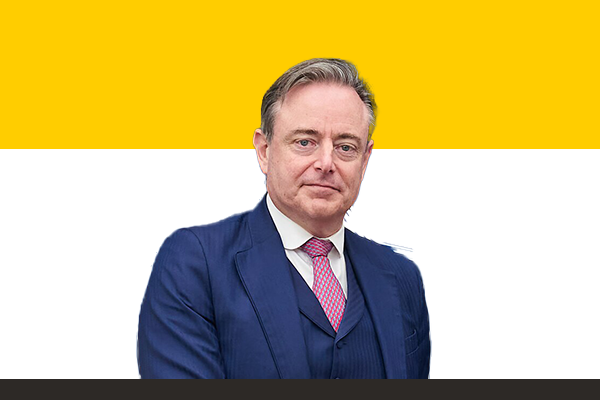
Bart Albert Liliane De Wever became Belgium’s Prime Minister on 3 February 2025, making history as the first Flemish nationalist to hold that office. He leads a broad coalition that reflects a mix of political traditions and regional interests. As Prime Minister, he steers Belgium through a time of fiscal reform, pension restructuring, and debates over regional autonomy.
Born on 21 December 1970 in Mortsel, De Wever studied history at the University of Antwerp before completing his education at KU Leuven. He worked briefly as a research assistant and doctoral candidate, but he abandoned an academic career to devote himself to politics.
Bart De Wever
In 2001, De Wever co-founded the New Flemish Alliance (N-VA), a party rooted in Flemish nationalism and conservative economic principles.
He rose quickly within the party, becoming its chairman in 2004. Under his leadership, N-VA transformed from a marginal movement into the largest political force in Flanders, advocating for greater regional autonomy and a confederal structure for Belgium.
influence extended beyond the party: from January 2013 until February 2025, he served as Mayor of Antwerp.
Bart De Wever
During his mayoralty, he focused on urban development, public order, and fiscal prudence. Meanwhile, he continued to exert leadership at the national level, serving multiple terms in both the Flemish and federal parliaments.
After the 2024 federal elections in Belgium, De Wever’s N-VA emerged as a dominant player. He negotiated for more than eight months with four other parties — including the Flemish socialists of Vooruit, the Christian democrats of CD&V, and two French-speaking parties — to form a coalition government
Once in power, he and his government proposed deep reforms. They aimed to limit the duration of unemployment benefits, adjust pension systems (reducing early retirement benefits while increasing incentives for those who work longer), and introduce a capital gains tax.
Reuters
The coalition also pledged stricter migration measures and a more rigorous fiscal policy to address Belgium’s budget deficit.
De Wever’s political journey reflects a significant evolution. Earlier in his career, he vocally supported Flemish independence and criticized the fiscal transfers to French-speaking regions.
But as Prime Minister, he adopted a more pragmatic tone, showing a willingness to govern at the national level and cooperate across linguistic divides.
His government marks a rare convergence of rightwing nationalism and multicommunity coalition politics.
Beyond politics, De Wever has authored several books and written opinion pieces for major newspapers.
Bart De Wever
He draws on his fascination with history — particularly ancient Rome — and often quotes Latin authors in his speeches. He lives in Deurne, near Antwerp, with his wife Veerle and their four children. He avoids alcohol, practices marathon running, and has completed races in cities like Athens.
Bart De Wever
As Prime Minister, De Wever confronts major challenges: navigating Belgium’s complex linguistic and regional divides, balancing social reform with fiscal responsibility, and shaping his legacy as a statesman. His remarkable rise—from historian and party founder to the highest office in the land—demonstrates both his political skill and his enduring influence in Belgian public life.