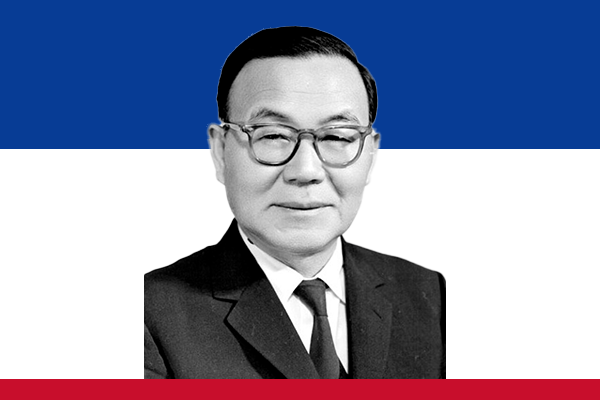
Mr. Yun Po-sun
In Office: 13 August 1960 – 24 March 1962
Political Party: Democratic Party
Home State: Asan
Lifespan: 1897–1990
Country: South Korea
Image credits available here.
Early Life and Education
Yun Po-sun was born on August 26, 1897, in Asan, Chungcheongnam-do, into a prominent yangban family. He grew up in a traditional Confucian environment, but he understood the importance of modern education. He attended Osan School and later studied in Japan and Scotland, where he gained exposure to Western political thought. His international education shaped his belief in constitutional governance and public service. With this background, he returned to Korea determined to contribute to the nation’s modernization.
Entry into Public Service
Yun entered public life after Korea regained independence from Japan in 1945. He worked with reform-minded leaders and supported the establishment of a democratic government. When the Republic of Korea formed in 1948, he quickly emerged as a respected figure. President Syngman Rhee appointed him Mayor of Seoul in 1948, and Yun used this opportunity to modernize the capital. He improved city administration, restored public order, and planned infrastructural development. His effective leadership strengthened his national reputation.
Rise to National Politics
Yun expanded his political influence when he won a seat in the National Assembly in 1954. He opposed Syngman Rhee’s attempt to extend presidential terms indefinitely and spoke strongly against authoritarian practices. His stance earned praise from pro-democracy groups. In 1955, he became a founding member of the Democratic Party, which challenged the ruling Liberal Party. As the political climate intensified, Yun emerged as one of the most credible opposition leaders.
Election as President
South Korea entered a turning point after the April Revolution of 1960, which forced President Rhee to resign. The nation adopted a parliamentary system, and the National Assembly elected Yun Po-sun as the second President of South Korea on August 13, 1960. While the new system limited presidential powers, Yun used his position to safeguard democratic reforms and support the newly appointed Prime Minister Chang Myon. He promoted transparency, emphasized constitutional limits on political authority, and encouraged moral leadership.
However, his presidency faced immense challenges. Economic instability, social unrest, and factional conflicts weakened the government. Yun tried to maintain stability, but the administration struggled to control growing public dissatisfaction.
Confrontation with Authoritarian Rule
On May 16, 1961, General Park Chung-hee led a military coup that toppled the parliamentary government. Yun Po-sun refused to endorse the coup and openly criticized military interference in politics. Although he formally remained President for a short period, the military controlled the state. Yun resigned in 1962 to protest the erosion of democracy. His decision demonstrated his commitment to constitutional governance, even during political turmoil.
Later Political Activities
Yun continued to advocate for democracy throughout the 1960s and 1970s. When Park Chung-hee consolidated power, Yun became a leading opposition figure. He frequently spoke against dictatorial policies and supported movements calling for free elections. Though the government often restricted his activities, he never abandoned his principles. After South Korea began democratizing in the 1980s, Yun supported the younger generation of reformists.
Legacy and Contribution
President Yun Po-sun left a profound mark on South Korean political history. He championed democracy during a time filled with instability and authoritarian threats. He inspired future leaders by defending parliamentary governance and resisting military rule. Koreans remember him as a statesman who valued integrity and national interest over personal power. His legacy lives on as a reminder that democratic progress often requires courage, sacrifice, and unwavering commitment.