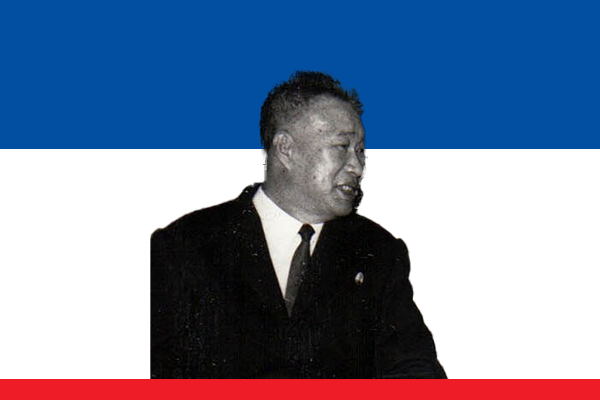
Mr. Kim Il
In Office: 28 December 1972 – 19 April 1976
Political Party: Workers’ Party of Korea
Home State: Hamgyon
Lifespan: 1910–1984
Country: North Korea
Image credits available here.
Early Life and Revolutionary Background
Born in 1912 during the period of Japanese colonial rule over Korea, Kim Il-sung grew up amid political repression and nationalist resistance. From a young age, he became involved in anti-Japanese guerrilla activities. His experiences as a revolutionary fighter strongly influenced his worldview, fostering a belief in armed struggle, self-reliance, and strict discipline. These early years helped craft the image of Kim as a heroic liberator, an image later amplified by state propaganda.
Rise to Power and Appointment as Prime Minister
After Japan’s defeat in World War II, Korea was divided along ideological lines. With support from the Soviet Union, Kim Il-sung emerged as a leading figure in the northern part of the peninsula. In 1948, when North Korea was formally established, Kim Il-sung became its first Prime Minister. In this role, he consolidated authority, sidelined rivals, and built a centralized political system under the Workers’ Party.
Leadership Style and Ideology
Kim Il-sung’s leadership style combined charisma, strict control, and ideological indoctrination. He promoted the Juche ideology, which emphasized political independence, economic self-sufficiency, and military self-reliance. Under his guidance, Juche evolved from a political slogan into a comprehensive state doctrine. Kim fostered a strong personality cult, portraying himself as the “Great Leader” and the father of the nation.
Domestic Policies and Governance
As Prime Minister, Kim Il-sung implemented sweeping land reforms, nationalized industries, and established a planned economy. These measures initially improved literacy, healthcare access, and industrial growth. However, over time, rigid central planning and prioritization of military spending strained the economy. Political dissent was not tolerated, and a vast security apparatus ensured loyalty to the regime.
Foreign Policy and the Korean War
Kim Il-sung played a decisive role in initiating the Korean War in 1950, aiming to reunify the peninsula under communist rule. The conflict devastated Korea and resulted in millions of casualties. After the war, Kim skillfully navigated relations with both the Soviet Union and China, balancing their influence while asserting North Korea’s independence. His foreign policy focused on regime survival and international recognition.
Legacy and Historical Impact
Kim Il-sung remained a dominant figure in North Korean politics until his death in 1994, even after transitioning from Prime Minister to President. His legacy is deeply embedded in North Korea’s political culture, institutions, and ideology. The dynastic succession he established ensured that power remained within his family, shaping the country’s leadership structure to this day.
Conclusion
Prime Minister Kim Il-sung was more than a political leader; he was the architect of North Korea’s state identity. Through revolutionary zeal, centralized control, and ideological innovation, he defined the trajectory of the nation. His influence continues to shape North Korea’s politics, society, and global posture, making him a pivotal figure in modern Korean history.