UZBEKISTAN
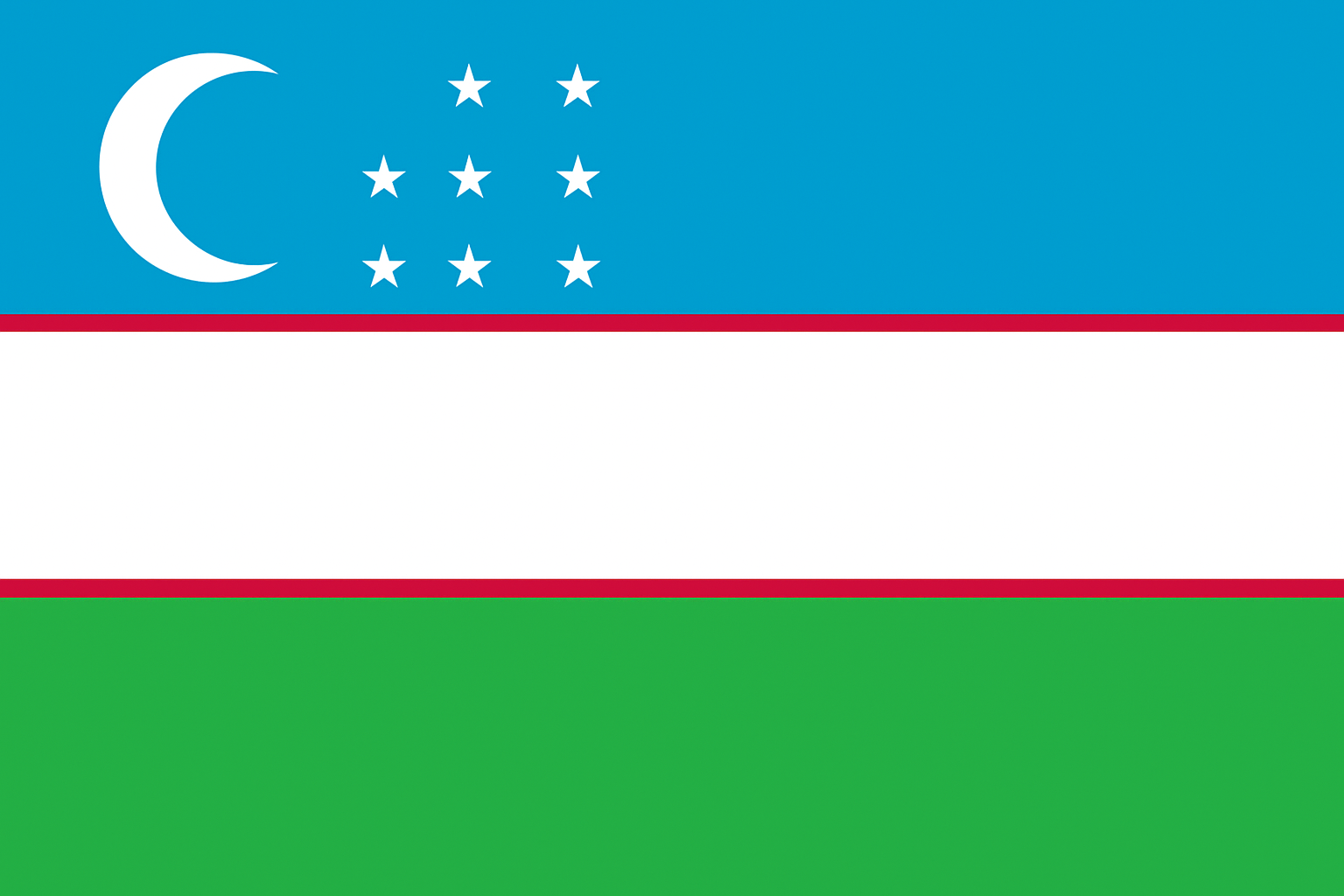
Flag of Uzbekistan
The flag of Uzbekistan consists of three horizontal stripes: blue at the top, white in the middle, and green at the bottom, separated by thin red lines. The blue symbolizes sky and water, the white represents peace and purity, and the green stands for nature and renewal. The red stripes signify life and vitality. A white crescent and twelve stars symbolize independence, spirituality, and cultural heritage.
Introduction
Uzbekistan is a landlocked country located in Central Asia, known for its rich history, ancient cities, and strategic position along the historic Silk Road. Bordered by Kazakhstan, Kyrgyzstan, Tajikistan, Afghanistan, and Turkmenistan, Uzbekistan has played a vital role in regional trade, culture, and politics for centuries. Today, it stands as an independent republic with a growing economy and a strong cultural identity.
Geography and Climate
Uzbekistan’s landscape consists mainly of deserts, plains, and river valleys, with the Kyzylkum Desert covering a large part of the territory. The country has a continental climate, marked by hot summers and cold winters. Major rivers such as the Amu Darya and Syr Darya support agriculture and settlements, although water management remains a key challenge.
Historical Background
Uzbekistan has a long and diverse history shaped by Persian, Greek, Arab, Mongol, and Turkic civilizations. Cities like Samarkand, Bukhara, and Khiva flourished as major centers of learning, trade, and architecture during the Silk Road era. In the 19th century, the region came under Russian control and later became part of the Soviet Union. Uzbekistan gained independence in 1991, marking a new chapter in its national development.
Government and Politics
Uzbekistan is a presidential republic. The president serves as both head of state and government, playing a central role in policymaking. In recent years, the country has undertaken political and administrative reforms, focusing on modernization, improved governance, and international cooperation.
Economy
The Uzbek economy is diverse and steadily expanding. Key sectors include agriculture, mining, manufacturing, and energy. Uzbekistan is one of the world’s leading producers of cotton and gold, and it also has significant reserves of natural gas. Economic reforms have encouraged foreign investment, private enterprise, and regional trade.
Culture and Society
Uzbek culture reflects a blend of Turkic traditions, Islamic heritage, and Central Asian customs. Music, dance, handicrafts, and cuisine play an important role in daily life. Traditional dishes like plov symbolize hospitality and community. The official language is Uzbek, and Islam is the predominant religion, practiced alongside other faiths in a spirit of tolerance.
Education and Modern Development
Uzbekistan places growing emphasis on education, technology, and youth development. Universities and vocational institutions are expanding, while digital initiatives aim to integrate the country into the global economy. Tourism is also rising, driven by historic architecture and cultural festivals.
Conclusion
Uzbekistan is a nation where ancient heritage meets modern ambition. With its strategic location, cultural richness, and ongoing reforms, the country continues to strengthen its role in Central Asia while preserving the legacy of its remarkable past.