UKRAINE
Ukraine Flag
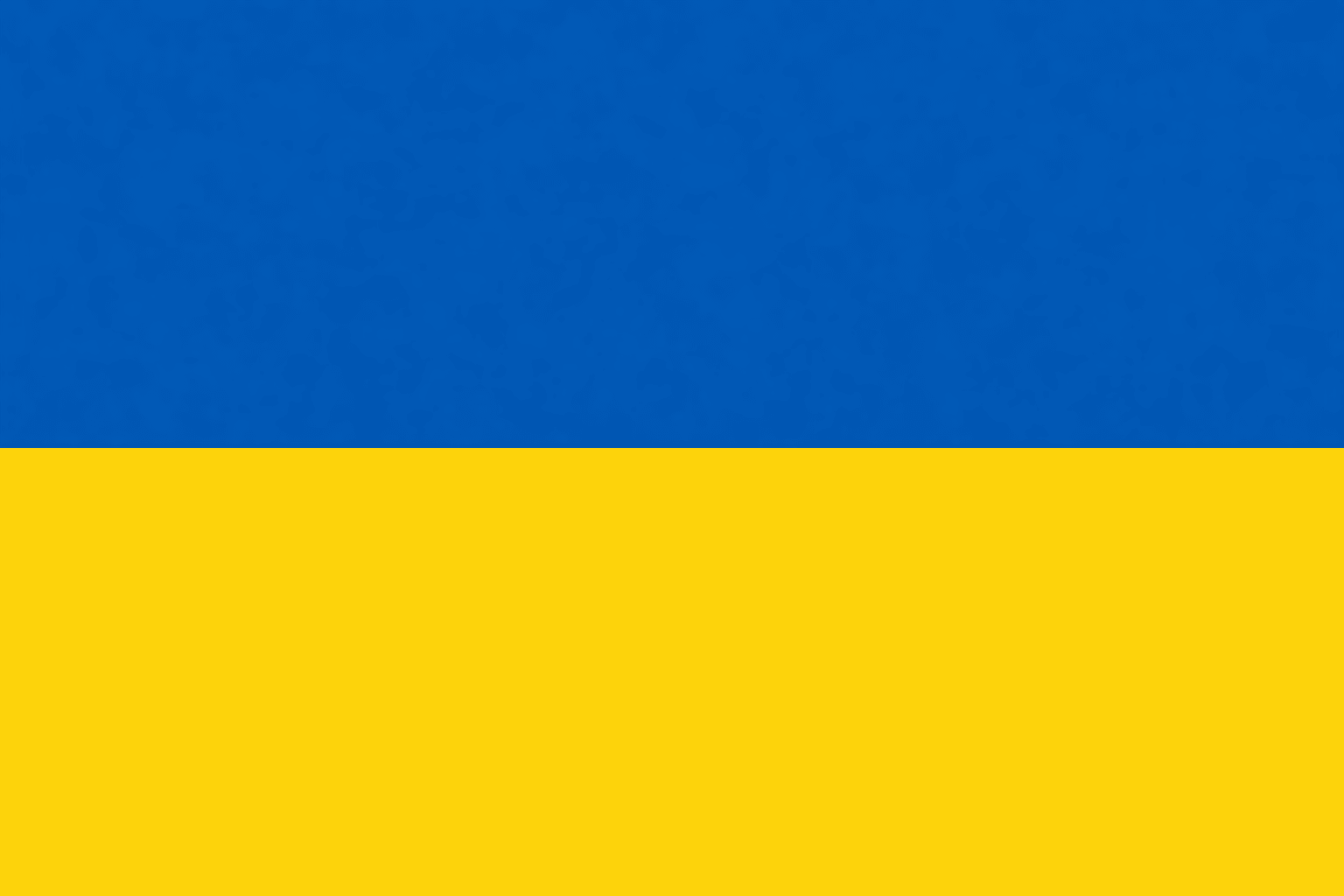
The flag of Ukraine is a powerful national symbol that represents the country’s history, identity, and hope. It consists of two equal horizontal bands: blue on the top and yellow on the bottom. The blue color symbolizes the clear sky, while the yellow represents golden wheat fields, reflecting Ukraine’s rich agricultural heritage. Officially adopted in 1992 after independence from the Soviet Union, the flag has become a strong emblem of freedom, unity, and national pride for the people of Ukraine.
Ukraine
Ukraine is one of the largest and most historically significant countries in Eastern Europe. Known for its fertile plains, rich cultural traditions, and strategic location, Ukraine has long played an important role in regional politics and trade. It shares borders with several countries, including Poland, Slovakia, Hungary, Romania, Moldova, Belarus, and Russia, while also having a coastline along the Black Sea and the Sea of Azov. Ukraine gained independence from the Soviet Union in 1991 and has since developed as a sovereign nation with its own political, economic, and cultural identity.
Geography and Location
Ukraine covers a vast area of approximately 603,000 square kilometers, making it the second-largest country in Europe after Russia. Its landscape consists mainly of plains, steppes, forests, and rivers. The Dnieper River is one of its most important waterways, flowing through the heart of the country. Ukraine’s fertile black soil, known as chernozem, makes it highly suitable for agriculture.
History
Ukraine has a long and complex history. It was once the center of the medieval state of Kyivan Rus, which is considered a cultural ancestor of both Ukraine and Russia. Over the centuries, Ukrainian lands were ruled by various powers, including the Polish-Lithuanian Commonwealth, the Russian Empire, and the Austro-Hungarian Empire. In the 20th century, Ukraine became part of the Soviet Union. On 24 August 1991, Ukraine declared independence, which was later confirmed by a national referendum.
Economy and Culture
Economy based on agriculture, industry, and natural resources. It is a major producer of wheat, corn, sunflower oil, and steel. The country also has significant deposits of coal, iron ore, and natural gas. Ukrainian culture is deeply rooted in folk music, dance, literature, and art. Traditional embroidered clothing, called vyshyvanka, is an important symbol of national identity.
Modern Importance
In recent years, Ukraine has gained global attention due to political tensions and conflict, especially after Russia’s annexation of Crimea in 2014 and the full-scale invasion in 2022. Despite these hardships, the Ukrainian people have shown extraordinary courage and determination. Ukraine remains important in international affairs, European security, and global food supply.
Conclusion
Ukraine is a country of rich history, natural beauty, and strong national spirit. Its journey through hardship and independence has made it a symbol of resilience and determination in the modern world.