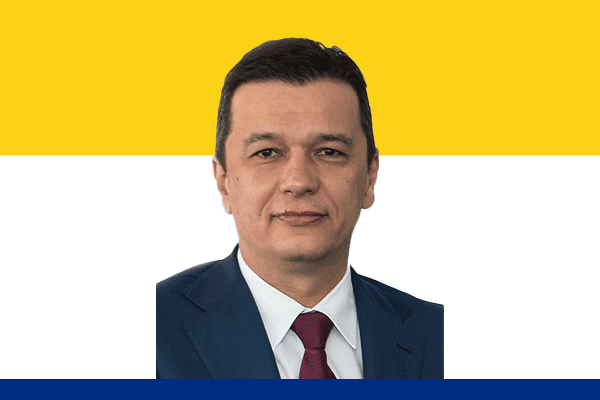
Early Life and Education
Sorin Mihai Grindeanu was born on December 5, 1973, in Caransebeș, a city located in the western region of Romania. He pursued higher education at the West University of Timișoara, where he studied computer science and mathematics. His academic background in technology and administration later influenced his work in government, particularly in the field of communications and information technology.
During his early years, Grindeanu developed a strong interest in public service and governance. He became actively involved in local politics and began building his reputation as a capable administrator and political organizer.
Political Career
Sorin Grindeanu joined the Social Democratic Party (PSD) and quickly rose through the ranks. Early in his career, he served as a local councilor in Timiș County. His leadership abilities were recognized, and he was later appointed Prefect of Timiș County in 2012. As prefect, he oversaw the implementation of government policies at the regional level and worked closely with local authorities to improve administrative efficiency.
In 2014, Grindeanu entered the national government when he became Minister for Communications and Information Society in the cabinet led by Victor Ponta. In this role, he promoted digital modernization and worked to expand Romania’s information technology infrastructure. His work in this ministry helped him gain recognition as a technically skilled politician capable of managing complex government programs.
Prime Minister of Romania
After the parliamentary elections of 2016, the Social Democratic Party (PSD) formed the government in Romania. In January 2017, Sorin Grindeanu was nominated as Prime Minister by party leader Liviu Dragnea and was officially appointed by the President of Romania, Klaus Iohannis.
As prime minister, Grindeanu led the Romanian government and implemented the party’s economic and administrative policies. His administration focused on increasing public sector wages, boosting economic growth, and improving infrastructure. However, his government soon faced major controversy.
In early 2017, the government introduced a decree that proposed changes to anti-corruption laws. Large public protests quickly erupted across Romania, as many citizens feared the reforms could weaken anti-corruption efforts. Demonstrations occurred in major cities, including Bucharest, and became some of the largest protests in Romania since the fall of communism.
Due to public pressure, the government withdrew the decree. However, political tensions within the ruling party continued to grow. In June 2017, the Social Democratic Party withdrew its support from Grindeanu’s government. A vote of no confidence was then passed by the Romanian parliament, which resulted in the end of his term as prime minister.
Later Political Roles
After leaving the prime minister’s office, Sorin Grindeanu remained active in Romanian politics. He continued serving as a member of parliament and later held important government positions. In 2021, he was appointed Minister of Transport and Infrastructure in the government led by Nicolae Ciucă. In this role, he worked on national transportation projects, including highway construction, railway modernization, and improvements in public transportation systems.
Grindeanu also served as Deputy Prime Minister of Romania, contributing to policy coordination and national development programs. His experience in both administrative and political leadership allowed him to remain a key figure in the Social Democratic Party.
Conclusion
Sorin Grindeanu’s political career illustrates the challenges of leadership during periods of political tension. Although his time as Prime Minister of Romania lasted only a few months, his government faced significant public debate and political change. Through his later roles in parliament and the transport ministry, Grindeanu continued to influence Romania’s infrastructure development and governance. His career reflects the evolving nature of Romanian politics and the ongoing efforts to balance economic growth, political stability, and democratic accountability.