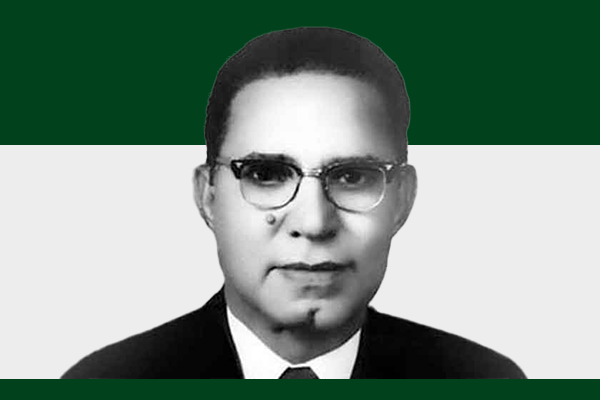
Mr. Fazal Ilahi Chaudhry
In Office: 14 August 1973 – 16 September 1978
Political Party: Pakistan People’s Party
Home State: Punjab, Pakistan
Lifespan: 1904–1982
Early Life and Education
Fazal Ilahi Chaudhry, the first ceremonial President of Pakistan under the 1973 Constitution, was born on January 1, 1904, in Kharian, a town in the Gujrat District of Punjab. Coming from a middle-class family, he pursued higher education with distinction. He earned degrees in arts and law from Aligarh Muslim University and the University of the Punjab, Lahore. His legal background and interest in politics led him to enter public service during the British colonial period.
Political Beginnings and Legislative Career
Fazal Ilahi began his political journey in pre-partition India as a member of the Unionist Party but later joined the All-India Muslim League, supporting the Pakistan Movement. After independence in 1947, he became an active member of the Punjab Provincial Assembly and soon transitioned into national politics. He was elected to the Constituent Assembly of Pakistan and held various legislative roles during the early years of the country.
Over the years, he aligned with different political factions and gained recognition as a seasoned and principled politician. He served multiple terms as a Member of the National Assembly and was respected for his calm demeanor and legal insight, especially in legislative matters.
Association with Pakistan People’s Party (PPP)
In the late 1960s, Fazal Ilahi Chaudhry joined the Pakistan People’s Party (PPP) led by Zulfikar Ali Bhutto. As a senior member of the PPP, he played a vital role in parliamentary activities and contributed to the framing of the 1973 Constitution. He was elected Speaker of the National Assembly in 1972, a position he held with integrity and impartiality. His leadership during this time helped stabilize Pakistan’s democratic institutions after the 1971 crisis.
Presidency (1973–1978)
Following the adoption of the 1973 Constitution, Pakistan transitioned from a presidential to a parliamentary system, making the presidency a largely symbolic role. Zulfikar Ali Bhutto, as Prime Minister, nominated Fazal Elahi Chaudhry as President due to his non-controversial and loyal reputation. He took office on August 14, 1973, becoming the first President under the new constitution and the last to be elected by a joint sitting of Parliament.
Though he held limited executive powers, Chaudhry fulfilled his constitutional duties with dedication and dignity. His presidency coincided with major political events, including Bhutto’s growing authoritarianism and eventual removal by General Zia-ul-Haq in 1977. Despite the military coup, Fazal Ilahi remained President until September 1978, when he resigned—making way for General Zia to assume full control.
Later Life and Legacy
After stepping down from the presidency, Fazal Ilahi Chaudhry retired from politics. He passed away on June 2, 1982. While he never wielded significant power, his role was vital in maintaining a sense of constitutional continuity during a period of political upheaval.
Legacy
Fazal Elahi Chaudhry is remembered for his modesty, legal acumen, and adherence to democratic principles. His presidency symbolized a transitional phase in Pakistan’s political evolution—from military-led governance to a civilian parliamentary system. Despite limited influence, he remains respected as a figure of stability and integrity in Pakistan’s political history.