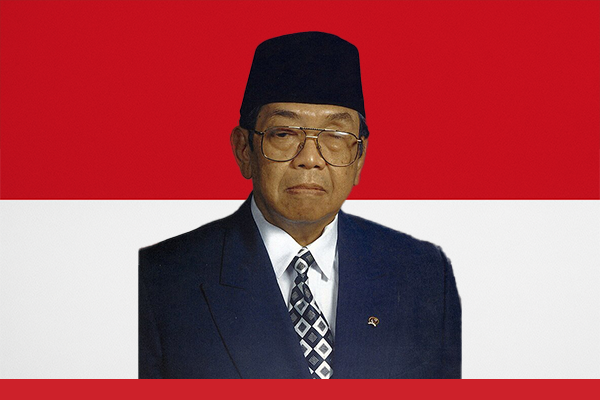
Abdurrahman Wahid
In Office: 20 October 1999 – 23 July 2001
Political Party: National Awakening Party
Home State: Jombang Regency
Lifespan: 1940–2009
Country: Indonesia
Image credits available here.
Early Life and Education
Abdurrahman Wahid, widely known as Gus Dur, was born on September 7, 1940, in Jombang, East Java, Indonesia. He came from a prominent Muslim family deeply rooted in religious scholarship and national leadership. His grandfather founded Nahdlatul Ulama (NU), Indonesia’s largest Islamic organization, while his father served as a minister in the early years of independence. Gus Dur absorbed strong religious and nationalist values from his family. He studied at several Islamic boarding schools before pursuing higher education in Cairo and Baghdad, where he deepened his knowledge of Islam and social sciences. His education shaped his belief in tolerance, pluralism, and modern interpretation of Islamic values.
Rise in Politics and Leadership in Nahdlatul Ulama
Abdurrahman Wahid returned to Indonesia with a mission to modernize Islamic thought and promote democracy. In 1984, he became the chairman of Nahdlatul Ulama, leading the organization through reform and renewal. He encouraged NU to separate from politics and focus on social and educational development. Under his leadership, NU became a powerful moral force advocating for human rights, interfaith dialogue, and social justice. Gus Dur used his platform to challenge authoritarian practices under President Suharto and to defend freedom of expression. His reputation as an intellectual and reformist thinker attracted national attention.
Path to the Presidency
After the fall of Suharto in 1998, Indonesia entered an era of democratic transition. Gus Dur played a vital role in shaping the political landscape through his leadership of the National Awakening Party (PKB). In 1999, the People’s Consultative Assembly elected him as Indonesia’s fourth president. His election symbolized a new chapter for Indonesia—a nation seeking unity after decades of centralized power. Gus Dur became the first democratically elected president from a traditional Islamic background, marking a milestone in Indonesia’s political evolution.
Reforms and Democratic Achievements
As president, Abdurrahman Wahid focused on strengthening democracy, human rights, and regional autonomy. He lifted restrictions on the Chinese community, allowing them to celebrate their culture openly. He promoted freedom of the press and encouraged open political debate. Gus Dur dissolved the powerful Ministry of Information to eliminate state control over media. He also sought peace in conflict areas such as Aceh and Papua by initiating dialogues and promoting reconciliation. His commitment to pluralism and equality reflected his belief that Indonesia’s strength lay in its diversity.
Challenges and Downfall
Despite his noble intentions, Wahid’s presidency faced numerous challenges. Political rivalries, economic instability, and miscommunication with parliament created tension within the government. Many criticized his leadership style as unconventional and erratic, though his supporters viewed him as independent and visionary. His efforts to reform military and bureaucratic structures met resistance from entrenched elites. In 2001, the parliament voted to remove him from office. Gus Dur accepted his dismissal peacefully, showing his respect for democratic institutions and setting a precedent for constitutional transition.
Legacy and Impact
Abdurrahman Wahid continued to serve as a moral leader after leaving office. He remained active in promoting interfaith harmony, human rights, and tolerance. Many Indonesians admired his humility, humor, and deep compassion for marginalized groups. His leadership encouraged Indonesians to embrace democracy with integrity and inclusiveness. When he passed away on December 30, 2009, the nation mourned the loss of a true champion of humanity.
Conclusion
President Abdurrahman Wahid transformed Indonesia’s political and social landscape with his vision of democracy and pluralism. He led with courage and faith, emphasizing that unity comes from understanding, not fear. His presidency may have been brief, but his influence endures in the democratic spirit of Indonesia. Through his actions, Gus Dur proved that leadership rooted in wisdom, compassion, and justice can leave a lasting legacy for generations.