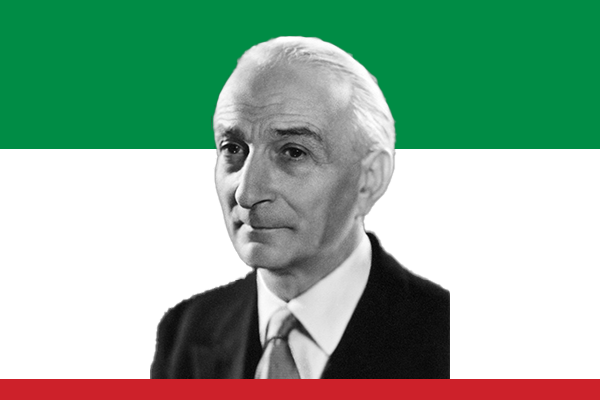
Early Life and Education
Antonio Segni was born on February 2, 1891, in Sassari, Sardinia. He pursued a degree in law at the University of Sassari, where he later served as a professor. Segni actively immersed himself in academic and social issues, developing strong principles about justice, law, and democratic governance. His intellectual background prepared him for the complex challenges he would face in politics and public administration.
Entry into Politics
After World War II, Segni actively participated in the re-establishment of Italian democracy. He joined the newly formed Christian Democracy (Democrazia Cristiana) party, which became a dominant political force in post-war Italy. He played a key role in drafting Italy’s new constitution, contributing his legal expertise to build democratic institutions. His early political work emphasized reconstruction, social welfare, and the restoration of moral and political stability after the Fascist era.
Prime Ministerial Leadership
Antonio Segni served twice as Prime Minister of Italy — first from 1955 to 1957 and again from 1959 to 1960. During his tenure, he actively promoted agricultural reforms, economic growth, and political moderation. He introduced policies to modernize Italy’s agricultural sector and strengthen rural economies, ensuring fairer land distribution and improved productivity. Segni’s government emphasized stability and cooperation, maintaining balance among diverse political factions while reinforcing Italy’s international alliances, especially with NATO and the European Economic Community (EEC).
Presidency of the Republic
In 1962, Antonio Segni became the fourth President of the Italian Republic. As president, he actively defended the constitution and maintained Italy’s democratic framework during turbulent political times. Segni exercised his constitutional powers carefully, striving to maintain impartiality while ensuring the government adhered to democratic norms. He supported coalition governments and encouraged cooperation among parties to prevent instability.
Segni’s presidency coincided with Italy’s growing industrialization and social transformation. He actively represented Italy on the international stage, fostering diplomatic relations and promoting European unity. His tenure also witnessed political crises that tested his leadership and health. Despite challenges, he consistently prioritized constitutional integrity and national unity over partisan interests.
Later Years and Retirement
In 1964, Segni suffered a serious stroke that forced him to step down from office the following year. After resigning, he retired from public life but remained a respected figure in Italian politics. He continued to inspire future generations through his dedication to democracy and his ethical approach to leadership. Antonio Segni passed away on December 1, 1972, leaving behind a legacy of service and moderation.
Legacy and Influence
Antonio Segni’s legacy lives on as a symbol of integrity, balance, and democratic commitment. He actively worked to stabilize Italian politics during a period of great change, combining legal expertise with political wisdom. His reforms in agriculture and governance helped lay the foundation for Italy’s modern development.
Segni’s presidency demonstrated the importance of moral leadership and civic responsibility in preserving democratic institutions. His vision of a balanced, cooperative, and constitutional Italy continues to influence scholars, politicians, and citizens who value principled governance and public service.
Conclusion
President Antonio Segni’s career embodied dedication, intellect, and integrity. From his academic beginnings to his leadership as Prime Minister and President, he actively shaped Italy’s post-war transformation. His actions strengthened democracy, modernized the economy, and preserved national unity. Through his steady and ethical leadership, Segni earned his place among the architects of modern Italy.