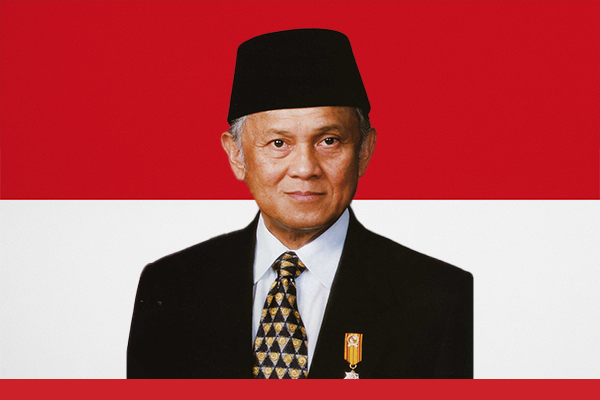
President B. J. Habibie: Indonesia’s Visionary Leader and Technocrat
Bacharuddin Jusuf Habibie, widely known as B. J. Habibie, played a pivotal role in Indonesia’s political and technological landscape. Born on June 25, 1936, in Parepare, South Sulawesi, Habibie demonstrated a profound passion for science and technology from an early age. He pursued aeronautical engineering at the Institut Teknologi Bandung (ITB), where he distinguished himself with exceptional talent and innovation.
Early Career and International Recognition
After completing his studies in Indonesia, Habibie moved to Germany to advance his career in aerospace engineering. There, he worked for the German aerospace company Messerschmitt-Bölkow-Blohm (MBB), quickly rising through the ranks due to his groundbreaking contributions. He specialized in aircraft design and stress analysis, earning international recognition for his expertise. Habibie applied his innovative ideas to improve aircraft safety, which earned him respect in global engineering circles.
During his time in Germany, Habibie maintained close ties with Indonesia. He envisioned transferring his knowledge to develop Indonesia’s aerospace industry. His technical prowess and visionary thinking made him an ideal candidate for leadership roles in the country’s burgeoning technological sector.
Return to Indonesia and Ministerial Role
In 1974, President Suharto appointed Habibie as Indonesia’s Minister of Research and Technology. Habibie immediately implemented reforms to strengthen the country’s scientific and technological infrastructure. He focused on fostering innovation in aviation and engineering, establishing research centers, and encouraging collaboration between local and international experts. Under his leadership, Indonesia advanced its aerospace capabilities, laying the foundation for the national aircraft industry.
Habibie’s work as a minister demonstrated his ability to merge technical expertise with strategic vision. He actively promoted the development of Indonesia’s first domestically produced aircraft, the N-250, which showcased his commitment to technological self-reliance. His achievements earned him admiration from both scientists and policymakers.
Presidency and Political Leadership
Following Suharto’s resignation in May 1998, Habibie assumed the presidency during a turbulent period marked by economic crisis and political unrest. He acted decisively to stabilize the nation and restore public confidence. Habibie initiated democratic reforms, including lifting restrictions on political parties and press freedom, and conducted Indonesia’s first free parliamentary elections in decades.
He faced immense challenges but approached them with rationality and pragmatism. Habibie prioritized transparency and accountability, striving to strengthen Indonesia’s democratic institutions. His leadership helped guide the country through a critical transitional period, leaving a lasting impact on Indonesia’s political evolution.
Legacy and Contributions
After completing his presidency in 1999, Habibie continued contributing to science and education. He supported technological research, mentorship programs, and initiatives to nurture Indonesia’s young engineers. Habibie emphasized the importance of innovation for national progress and inspired a generation of scientists and engineers to pursue excellence.
B. J. Habibie passed away on September 11, 2019, leaving behind a legacy defined by intellect, vision, and patriotism. He transformed Indonesia’s aerospace industry, championed democratic reforms, and served as a symbol of dedication to national development. Today, Indonesia honors him as a leader who combined technological mastery with compassionate governance.