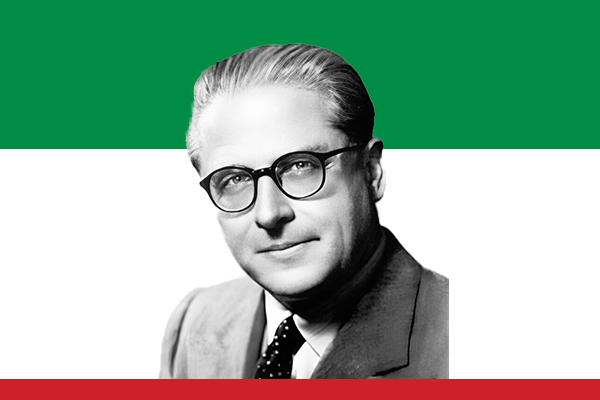
Early Life and Political Foundation
Giovanni Gronchi was born on September 10, 1887, in Pontedera, Tuscany. He grew up in a middle-class family that valued education and faith. After completing his studies in literature and philosophy, he began teaching before turning to politics. In the early 20th century, Gronchi joined the Italian People’s Party, founded by Don Luigi Sturzo, to promote Christian democracy and social justice.
During his early political career, Gronchi actively defended workers’ rights and supported democratic institutions. When Benito Mussolini rose to power, Gronchi opposed the Fascist regime. He refused to compromise his democratic ideals, which led him to withdraw from public life during much of the dictatorship.
Return to Politics and Founding of the Christian Democracy
After World War II, Gronchi re-entered politics with determination. He helped found the Christian Democracy (Democrazia Cristiana) party, which became Italy’s dominant post-war political force. In 1946, Italians voted to establish a republic, and Gronchi played a crucial role in drafting the new Italian Constitution.
He actively worked to ensure that the new government protected both social rights and personal freedoms. His belief in balancing moral values with modern governance earned him respect across political and religious groups.
Presidency and Domestic Policies
In 1955, Parliament elected Giovanni Gronchi as the third President of Italy. As president, he actively pursued a vision of social inclusion and national renewal. He sought to bridge the political gap between conservatives and socialists, advocating for a broader democratic coalition. Gronchi believed that Italy could only achieve true progress through unity and cooperation among all political forces.
Domestically, he supported industrial expansion, educational reform, and public welfare initiatives. He encouraged policies that improved living standards, expanded employment opportunities, and reduced regional inequalities. By supporting economic modernization, Gronchi helped Italy transition from a war-torn nation to a rapidly developing industrial power.
Foreign Policy and International Diplomacy
On the global stage, President Gronchi worked to strengthen Italy’s position in international affairs. He actively promoted Italy’s integration into Europe and its partnership with both Western and Mediterranean nations. Although Italy was a member of NATO, Gronchi believed in maintaining open dialogue with countries from the Eastern bloc.
He traveled extensively to promote diplomacy and foster mutual understanding between nations. His commitment to peace and cooperation reflected Italy’s desire to play a constructive role in the Cold War era. Gronchi’s foreign policy approach emphasized independence, neutrality, and dialogue, aligning with his vision of a balanced and peaceful world.
Challenges and Legacy
Despite his achievements, Gronchi faced political challenges during his presidency. His efforts to bring left-wing parties into the government met resistance from conservative factions. His independent approach occasionally clashed with the parliamentary system, creating moments of political tension.
However, Gronchi’s presidency left a lasting legacy. He strengthened the moral and democratic foundations of Italy’s Republic and laid the groundwork for social and economic transformation. Even after leaving office in 1962, he remained active in public life, advocating for democracy, peace, and Christian values until his death in 1978.
Conclusion
Giovanni Gronchi stands out as a visionary leader who actively shaped modern Italy. His presidency reflected courage, innovation, and a commitment to democratic values. By bridging divides and promoting cooperation, he helped Italy emerge from its post-war struggles and move toward stability and progress. Gronchi’s legacy continues to symbolize unity, integrity, and hope in the Italian Republic’s history.