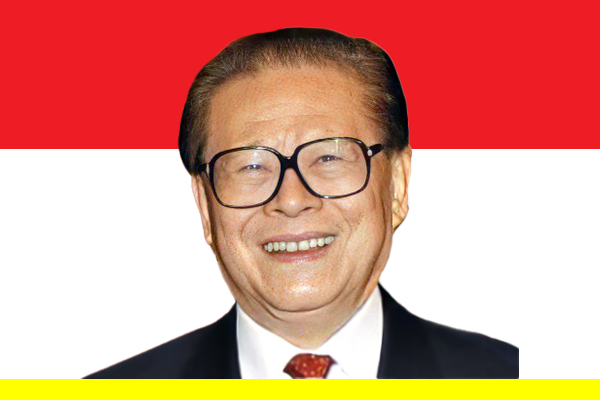
Mr. Jiang Zemin
Name: Mr. Jiang Zemin
In Office- Term 1: 15/03/1993 – 17/03/1998
Term 2: 17/03/1998 – 16/03/2003
Political Party: Community Party of China
Home State: Jiangsu, China
Lifespan: 1926 – 2022
Early Life and Political Career
Jiang Zemin was born on August 17, 1926, in Yangzhou, Jiangsu province, China. He graduated from Shanghai Jiao Tong University in 1947 with a degree in electrical engineering. Jiang joined the Chinese Communist Party (CCP) during his university years and began his career in the machinery and electronics industries. He rose steadily through the party and government ranks, serving in various technical and administrative roles. By the 1980s, he had become Minister of the Electronics Industry and later the Party Secretary of Shanghai, where he gained national attention for his pragmatic leadership and commitment to reform.
Rise to Power After Tiananmen
Jiang’s political ascent accelerated following the 1989 Tiananmen Square protests. In the aftermath of the crackdown, he was chosen to replace Zhao Ziyang as General Secretary of the CCP. Jiang was viewed as a safe and loyal figure who could restore order while continuing China’s reform agenda. In 1993, he also became President of China and Chairman of the Central Military Commission, consolidating his position as the country’s top leader.
Economic Reforms and WTO Membership
During Jiang’s tenure, China experienced significant economic transformation. He continued and expanded the market-oriented reforms initiated by Deng Xiaoping. Jiang championed modernization, encouraged foreign investment, and promoted the growth of the private sector. His most notable achievement was leading China into the World Trade Organization (WTO) in 2001, a milestone that integrated the country more deeply into the global economy and spurred rapid industrialization and export-led growth.
The “Three Represents” Theory
To adapt the Communist Party to China’s evolving society, Jiang introduced the “Three Represents” theory. This ideological framework stated that the CCP should represent advanced productive forces, advanced culture, and the interests of the majority. By including entrepreneurs and professionals in the party’s base, Jiang modernized its composition and broadened its appeal. This shift helped the CCP maintain relevance amid economic liberalization and social change.
Foreign Relations and National Sovereignty
Jiang also played an important role in China’s foreign policy. He managed complex relations with major powers, especially the United States, navigating diplomatic crises like the 1999 NATO bombing of the Chinese embassy in Belgrade and the 2001 Hainan Island incident. Under his leadership, Hong Kong and Macau were returned to Chinese sovereignty in 1997 and 1999 respectively, under the “one country, two systems” principle.
Retirement and Legacy
Jiang stepped down from his top posts in the early 2000s, handing power to Hu Jintao, but remained influential behind the scenes for several years. He died on November 30, 2022, at the age of 96. Jiang Zemin is remembered as a stabilizing figure who guided China through a critical era of transformation. His leadership balanced continued economic reform with political control, and his legacy is marked by the modernization of China and its emergence as a global power.