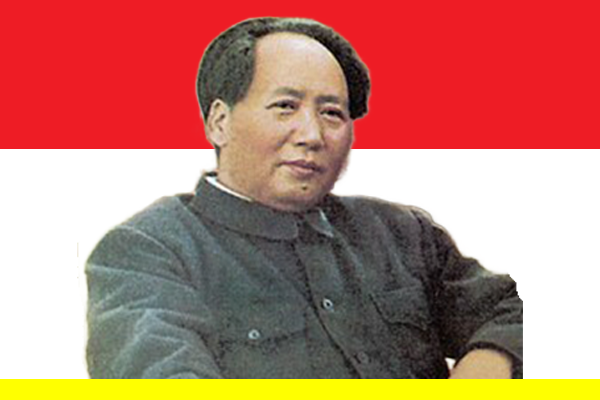
Mr. Mao Zedong
In Office: 27 September 1954 – 27 April 1959
Political Party: The Chinese Communist Party
Home State: Hunan, China
Lifespan: 1893 – 1976
Introduction
Mao Zedong (born on 26th December 1893 in Shaoshan, Hunan province, China – passed away on 9th September 1976 in Beijing) was a prominent Chinese Marxist thinker, revolutionary leader, and statesman. He played a pivotal role in leading China’s communist movement. Mao served as the head of the Chinese Communist Party (CCP) from 1935 until his death. He was the Chairman (equivalent to Head of State) of the People’s Republic of China from 1949 to 1959. Mao remained a central figure in China’s political and ideological landscape.
China emerged from half a century of revolution as the world’s most populous country. It began a new journey of economic and social change. Mao Zedong played a central and historic role in this revival. He did not always hold dominant power throughout the struggle. In the CCP’s early years, he was a secondary but notable figure. After the 1940s, key decisions were often shared, except perhaps during the Cultural Revolution. From the founding of the CCP in 1921 to Mao’s death in 1976, he shaped the course of modern China.
Early Life
Mao Zedong was born in Shaoshan, Hunan province, to a prosperous peasant family. His village valued education mainly for practical tasks. He studied the Confucian Classics before leaving school at age 13. Mao was then required to work full-time on his family’s farm. He rejected his father’s authority and an arranged marriage. Mao left home to study at schools in nearby counties and eventually in Changsha. There, he encountered reformist ideas and thinkers like Liang Qichao and Sun Yat-sen.
In 1911, he witnessed the fall of the Qing dynasty and briefly joined the revolutionary army in Hunan. The experience left a lasting impression. It strengthened his admiration for military heroes. Mao later explored careers in law, business, and teaching. He then turned to deeper academic study and read widely. This reflected China’s confusion about whether Chinese or Western education was best. In 1918, Mao graduated from the First Provincial Normal School in Changsha. He also became active in student movements. He co-founded the New People’s Study Society, whose members later joined the CCP.
That same year, he moved to Beijing and worked at Peking University as a library assistant. There, he met Li Dazhao and Chen Duxiu, who would found the CCP. Mao was in Beijing during the May Fourth Movement of 1919. The movement pushed young intellectuals away from Western liberalism. They turned to Marxism-Leninism as a solution to China’s problems. In 1919, Mao returned to Changsha to organize student and worker protests. By early 1921, he fully accepted Marxism as his ideological path.
Mao and the Chinese Communist Party (CCP)
In 1920, Mao became principal of a primary school in Changsha. He soon organized a branch of the Socialist Youth League. That winter, he married Yang Kaihui. In 1921, he attended the First Congress of the Chinese Communist Party. When the CCP allied with Sun Yat-sen’s Nationalist Party in 1923, Mao joined the Nationalists. He worked with them and served on their Executive Bureau in Shanghai.
In late 1924, he returned to his hometown of Shaoshan for rest. There, he witnessed peasant protests triggered by police killings in Shanghai. These events had a deep effect on him. Mao had once viewed peasants as backward and unorganized. But he now saw their potential for revolution. He began organizing peasant associations in Hunan. This marked a shift from focusing on urban workers to mobilizing the rural population. That rural strategy became central to his future political campaigns.
Know about 2nd Chairman of the Chinese Communist Party : Liu Shaoqi