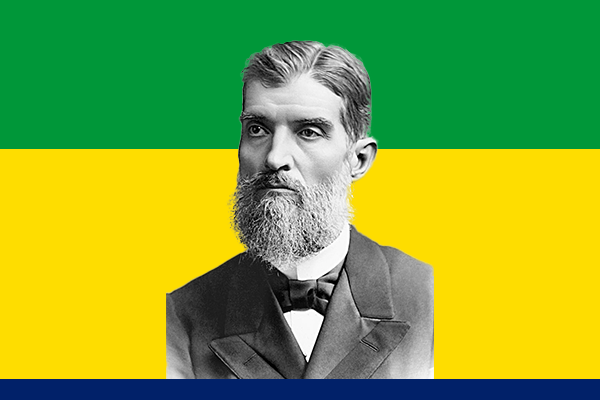
Early Life and Political Rise
Prudente José de Morais e Barros was born on October 4, 1841, in Itu, São Paulo. He came from a modest background but pursued education with determination. After studying law at the prestigious Faculty of Law in São Paulo, he entered politics, driven by his commitment to republican ideals. Morais began his political career as a provincial deputy and later became the president of the province of São Paulo. His strong oratory and organizational skills earned him recognition as a leading voice in Brazil’s early republican movement.
When Brazil transitioned from monarchy to a republic in 1889, Morais actively supported the new government. He became a member of the Constituent Assembly that drafted the first Republican Constitution of 1891. His influence grew rapidly, and his civilian perspective offered a balance to the dominant military leadership of the time.
Becoming Brazil’s First Civilian President
In 1894, Prudente de Morais won the presidential election, becoming the first civilian to lead Brazil after the military-dominated early years of the republic. He took office on November 15, 1894, determined to bring stability to a nation struggling with political unrest and regional revolts.
Morais prioritized civilian authority and sought to reduce the military’s political influence. He faced challenges from factions still loyal to the monarchy and from rival republican groups. Despite the divisions, he pursued national unity and emphasized law, order, and democratic governance.
Leadership During the Federalist Revolution
One of the most significant challenges of Morais’s presidency was the Federalist Revolution in southern Brazil. The civil war, which had started before his presidency, continued to threaten national stability. Morais acted decisively to end the conflict. He supported the army in suppressing the rebellion while simultaneously working toward reconciliation. By 1895, the government achieved peace, restoring control and strengthening the legitimacy of civilian rule.
After the war, Morais focused on rebuilding the nation. He encouraged economic growth through agricultural expansion, particularly in coffee production, which became Brazil’s main export. His administration also promoted infrastructure projects to improve trade and communication between regions.
Promoting Civilian Democracy and Stability
President Morais constantly defended constitutional order and civilian supremacy. He dealt with opposition firmly but fairly, ensuring that democratic institutions developed under his leadership. When internal political crises erupted, such as the 1897 Naval Revolt, he responded with firmness and sought to maintain national stability without abandoning constitutional principles.
He also worked to restore Brazil’s reputation abroad. His administration negotiated peaceful relations with neighboring countries and focused on diplomatic respect. Domestically, he encouraged modernization in governance and improved public administration efficiency.
Challenges and Assassination Attempt
In 1897, Morais faced a grave personal and political crisis. During a public ceremony, a member of the army attempted to assassinate him. Although he survived the attack, the event highlighted ongoing tensions between the civilian government and the military. Despite the setback, Morais continued his duties, showing resilience and courage until his health began to decline.
Legacy and Death
Prudente de Morais left office in 1898, marking the end of a significant chapter in Brazil’s early republican history. He returned to his hometown and lived quietly until his death on December 3, 1902. His presidency laid the foundation for Brazil’s democratic traditions and civilian governance.
Morais is remembered as a symbol of moderation, integrity, and national unity. He transformed the presidency from a position of military dominance into a civilian institution dedicated to democratic progress. Through determination and diplomacy, he stabilized a young republic and ensured that civilian leadership could guide Brazil’s future.
Conclusion
President Prudente de Morais played a defining role in consolidating Brazil’s republican system. His commitment to peace, civilian authority, and democratic values helped Brazil transition from military rule to a stable, law-based government. His presidency stands as a testament to leadership through resilience, diplomacy, and faith in constitutional democracy.