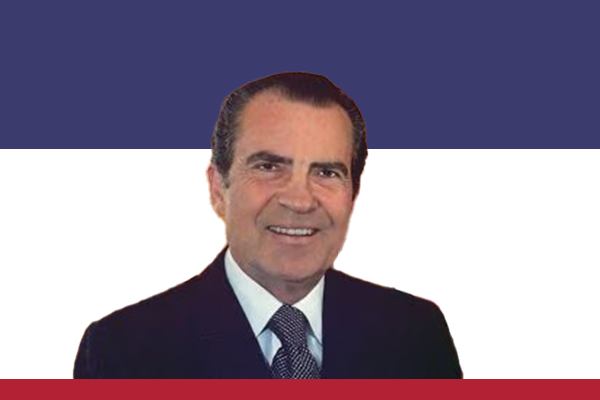
Mr. Richard Nixon
In Office: January 20, 1969 – August 9, 1974
Political Party: Republican
Home state: Yorba Linda
Lifespan: 1913–1994
Early Life and Political Career
Richard Milhous Nixon was born on January 9, 1913, in Yorba Linda, California, into a working-class Quaker family. He excelled academically and earned a law degree from Duke University in 1937. After working as an attorney, Nixon entered politics in 1946, winning a seat in the U.S. House of Representatives. He quickly gained a reputation as a strong anti-communist, notably for his role in exposing Alger Hiss. In 1950, he was elected to the U.S. Senate from California.
Vice Presidency and Early Setbacks
In 1952, Dwight D. Eisenhower selected Nixon as his running mate. Nixon served two terms as Vice President, becoming one of the most active in history. During this time, he survived early controversy with the famous “Checkers” speech, defending his integrity against accusations of financial misconduct. After narrowly losing the 1960 presidential election to John F. Kennedy and a failed 1962 bid for California governor, Nixon’s political future seemed bleak.
Presidential Victory and Domestic Policies
In 1968, Nixon made a stunning political comeback and was elected the 37th President of the United States. He won reelection in 1972 by a landslide. Domestically, Nixon’s policies included the creation of the Environmental Protection Agency (EPA) and enforcement of environmental laws. He also introduced wage and price controls to tackle inflation and supported programs like Title IX, which prohibited gender discrimination in federally funded education.
Foreign Policy and Global Diplomacy
Nixon’s presidency is particularly noted for its achievements in foreign policy. He adopted a pragmatic approach, seeking to ease Cold War tensions. In 1972, he made a historic visit to China, opening diplomatic relations and transforming global geopolitics. He also visited the Soviet Union, leading to the Strategic Arms Limitation Talks (SALT I) and agreements that helped reduce the threat of nuclear war.
In Vietnam, Nixon pursued a policy of “Vietnamization”—gradually withdrawing U.S. troops while increasing support for South Vietnamese forces. Though controversial, he eventually negotiated a ceasefire in 1973, ending American involvement in the war.
Watergate Scandal and Resignation
Nixon’s downfall came with the Watergate scandal, which began with a break-in at the Democratic National Committee headquarters in 1972. As investigations unfolded, it was revealed that Nixon had participated in a cover-up. Amid mounting pressure and facing certain impeachment, Nixon became the first U.S. president to resign from office, doing so on August 8, 1974. He was succeeded by Vice President Gerald Ford, who later granted him a full pardon.
Later Years and Legacy
Nixon spent his post-presidency writing memoirs and offering foreign policy advice. Though disgraced by Watergate, he gradually regained some public respect as a statesman. He died on April 22, 1994.
Conclusion
Richard Nixon’s legacy is marked by a blend of remarkable achievements and deep controversy. His diplomatic breakthroughs reshaped global relations, especially with China and the Soviet Union. Yet, the Watergate scandal severely damaged public trust in government and led to his unprecedented resignation. Nixon remains one of the most complex and consequential presidents in American history.