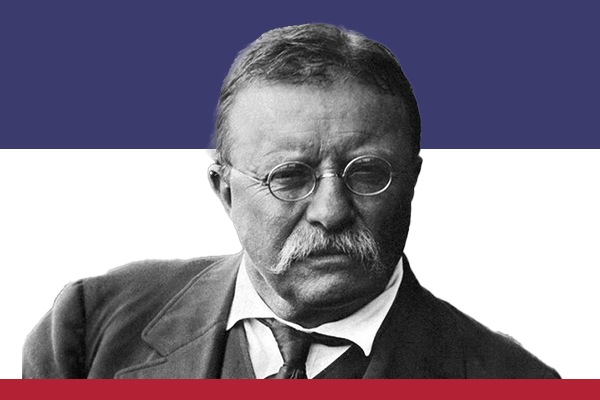
Mr. Theodore Roosevelt
In Office: 14 September 1901 – 4 March 1909
Political Party: Republican
Home state: New York
Lifespan: 1858–1919
Early Life and Political Rise
Theodore Roosevelt was born on October 27, 1858, in New York City into a wealthy family. Despite suffering from childhood asthma, he pursued physical fitness and adventure with determination. He attended Harvard University and briefly studied law before launching a political career. Elected to the New York State Assembly at age 23, Roosevelt quickly gained a reputation as a reformer fighting corruption.
Following the tragic deaths of his wife and mother on the same day in 1884, Roosevelt spent time in the Badlands of North Dakota as a rancher and cowboy. This period helped shape his rugged image. Returning to politics, he served in federal roles, including Civil Service Commissioner and Assistant Secretary of the Navy under President William McKinley.
War Hero and Governor of New York
Roosevelt achieved national fame during the Spanish-American War in 1898. As leader of the Rough Riders, he led a heroic charge up San Juan Hill in Cuba, becoming a war hero. This success propelled him into the governorship of New York, where he continued his progressive reforms and fought political corruption.
Vice President and Youngest U.S. President
In 1900, Roosevelt was chosen as McKinley’s running mate. After McKinley’s assassination in 1901, Roosevelt became the 26th President of the United States at age 42—the youngest in history. He brought vigor and a bold approach to the presidency, emphasizing strong executive leadership.
The Square Deal and Domestic Reforms
Roosevelt’s domestic agenda, called the Square Deal, aimed to balance the interests of business, labor, and consumers. He became known as a “trust buster,” using the Sherman Antitrust Act to break up powerful monopolies. He also supported labor rights, intervening in the 1902 coal strike to help workers gain fair wages and conditions.
Roosevelt championed significant reforms like the Pure Food and Drug Act and the Meat Inspection Act (1906), enhancing consumer safety and public health. His progressive policies reshaped the role of government in American life.
Conservation and Environmental Legacy
An avid naturalist, Roosevelt prioritized conservation. He preserved approximately 230 million acres of public land, creating five national parks 18 national monuments, and over 150 national forests. His efforts laid the foundation for the modern conservation movement.
Foreign Policy and International Influence
Roosevelt believed in a robust foreign policy, famously summed up by his phrase: “Speak softly and carry a big stick.”He expanded U.S. influence abroad, oversaw the construction of the Panama Canal, and mediated the Russo-Japanese War, earning the Nobel Peace Prize in 1906.
Later Years and Legacy
After leaving office in 1909, Roosevelt ran again for president in 1912 as a Progressive Party (Bull Moose) candidate, splitting the Republican vote and enabling Woodrow Wilson’s victory. He remained active until his death in 1919.
Conclusion
Theodore Roosevelt was a dynamic and visionary leader. His progressive reforms, dedication to conservation, and expansion of presidential power transformed the nation. He remains one of America’s most admired and impactful presidents.