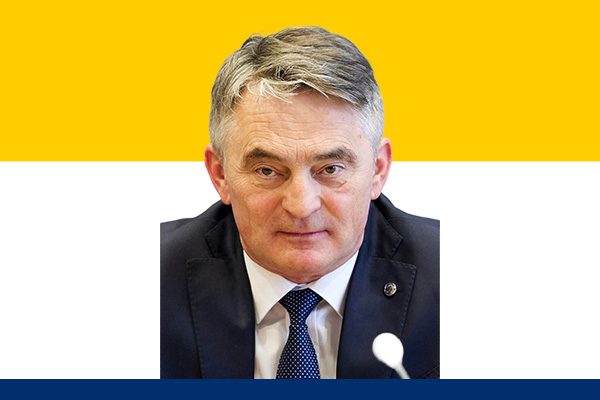
Mr. Zeljko Komsic
Assumed Office: 20 November 2018 – Incumbent
6 November 2006 – 17 November 2014
Political Party: Croatian Democratic
Home State: Čapljina
Lifespan: born 1964
Country: Bosnia and Herzegovina
Image credits available here.
Early Life and Education
Željko Komšić was born on 20 January 1964 in Sarajevo, Bosnia and Herzegovina, which was then part of the former Yugoslavia. He completed his early education in Sarajevo and later earned a law degree from the University of Sarajevo. During the Bosnian War (1992–1995), he served in the Army of the Republic of Bosnia and Herzegovina. His military service demonstrated his commitment to defending his homeland during one of the most challenging periods in its history.
Entry into Politics
After the war, Komšić entered politics with the aim of helping rebuild Bosnia and Herzegovina. He initially joined the Social Democratic Party (SDP), where he quickly gained recognition for his leadership skills and dedication to democratic values. As a member of the SDP, he served in several public offices and worked to promote reforms, transparency, and cooperation among the country’s diverse communities.
In 2013, he founded the Democratic Front (DF), a political party that emphasizes civic values, social justice, and equal opportunities for all citizens. Through this platform, he continued to advocate for political reforms and stronger democratic institutions.
Presidency and Political Leadership
Željko Komšić has served several terms as the Croatian member of the Presidency of Bosnia and Herzegovina. In this role, he has represented the country in international meetings, strengthened diplomatic relations, and promoted Bosnia and Herzegovina’s aspirations for closer ties with the European Union and NATO.
He has consistently argued that political representation should be based on citizenship rather than ethnic identity. His vision focuses on creating a stable, democratic nation where all citizens have equal rights and responsibilities. This position has earned him praise from supporters who favor civic politics, while critics have questioned his electoral legitimacy due to the country’s complex constitutional system.
Major Contributions
Komšić has contributed significantly to Bosnia and Herzegovina’s political development. He has promoted democratic governance, encouraged cooperation among different ethnic communities, and supported efforts to strengthen state institutions. His leadership has emphasized national unity and peaceful dialogue.
He has also advocated for European integration, believing that membership in European institutions would bring greater political stability, economic growth, and improved opportunities for citizens. His commitment to international cooperation has helped maintain Bosnia and Herzegovina’s presence in regional and global affairs.
Challenges and Controversies
Like many leaders in Bosnia and Herzegovina, Komšić has faced political challenges throughout his career. His repeated election as the Croatian member of the Presidency has sparked debates among various political groups. Some Croatian political parties have argued that he does not adequately represent their interests, while his supporters maintain that he represents all citizens equally under democratic principles.
Despite these controversies, Komšić has remained active in public life and has continued advocating for constitutional reforms, democratic governance, and national unity.
Legacy
Željko Komšić remains one of the most influential political leaders in Bosnia and Herzegovina. His commitment to civic democracy, equal rights, and a unified state has shaped his political legacy. Although his career has generated debate, his efforts to strengthen democratic institutions and encourage peaceful coexistence have made a lasting impact on the country’s political landscape.
Conclusion
Željko Komšić has dedicated much of his life to public service, democratic governance, and the promotion of equal citizenship in Bosnia and Herzegovina. Through his military service, political leadership, and commitment to reform, he has become a key figure in the nation’s post-war development. His influence continues to shape discussions about democracy, national identity, and the future of Bosnia and Herzegovina.