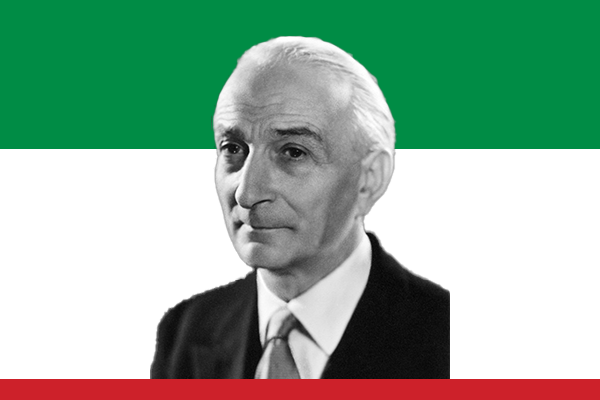
Early Life and Education
Antonio Segni was born on February 2, 1891, in Sassari, Sardinia. He grew up in a region rich in culture and tradition, which deeply influenced his worldview. Segni pursued a degree in law at the University of Sassari and later became a respected professor of agricultural law. His academic background helped him understand the importance of land reform, rural development, and social stability—issues that later defined his political agenda.
Entry into Politics
Segni entered politics as a member of the Christian Democracy Party (Democrazia Cristiana), a dominant force in Italy’s postwar political scene. He actively participated in shaping the country’s new democratic institutions after the fall of fascism. His pragmatic style, combined with his calm demeanor and intellectual strength, earned him respect among his colleagues and the Italian public. He served in several key ministerial roles, including as Minister of Agriculture, where he championed rural development and land reform initiatives.
Land Reforms and Economic Vision
As Minister of Agriculture, Segni played a decisive role in redistributing land to small farmers and modernizing Italy’s agricultural system. He actively implemented policies to improve rural living conditions and promote agricultural productivity. His land reforms reduced inequality and created new opportunities for thousands of families, strengthening the rural economy and stabilizing the nation’s social fabric. Segni’s practical and compassionate leadership earned him recognition as one of Italy’s foremost reformers of his time.
Prime Ministerial Tenures
Antonio Segni served twice as Prime Minister of Italy, first from 1955 to 1957 and again from 1959 to 1960. During his first term, he actively pursued political stability and economic modernization. He focused on strengthening Italy’s democratic institutions and promoting European integration. Segni supported Italy’s participation in the European Economic Community (EEC), recognizing the importance of unity for postwar recovery and prosperity.
In his second term, Segni continued his efforts to balance economic growth with social justice. He actively promoted industrial development while maintaining fiscal discipline. His government worked on strengthening Italy’s position in international affairs, fostering closer ties with Western allies, and ensuring that Italy remained a stable democracy amid Cold War tensions.
Presidency and Statesmanship
After his tenure as Prime Minister, Antonio Segni was elected President of the Italian Republic in 1962. As President, he actively safeguarded the Constitution and upheld the democratic process during a period marked by political instability. His commitment to constitutional principles ensured continuity and stability in Italy’s evolving political system. Despite suffering a severe stroke in 1964 that limited his ability to serve fully, Segni’s influence remained significant in shaping Italy’s democratic identity.
Legacy and Impact
Antonio Segni’s career reflected his deep belief in moderation, reform, and democratic governance. He actively worked to strengthen Italy’s institutions, promote social progress, and maintain political balance during times of uncertainty. His contributions to agriculture, European unity, and constitutional integrity have left an enduring mark on Italy’s history.
Even after his death on December 1, 1972, Segni’s legacy continues to inspire leaders who seek harmony between progress and stability. His example of quiet strength, moral integrity, and dedication to democratic values stands as a guiding light for future generations.