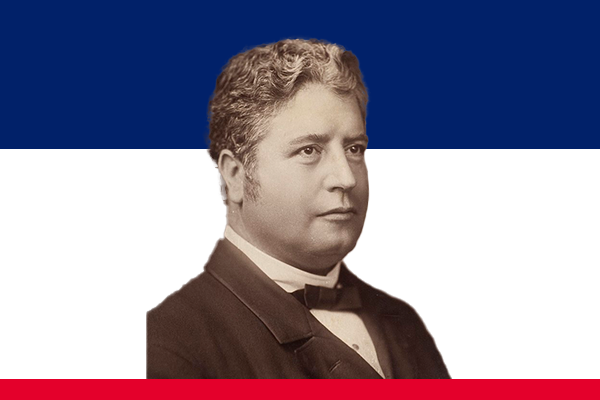
Early Life and Education
Edmund Barton was born on January 18, 1849, in Glebe, Sydney. His parents, William Barton and Mary Louise Barton, provided him with a strong educational foundation. He attended Fort Street Model School before moving on to Sydney Grammar School, where he excelled academically. Barton then pursued higher education at the University of Sydney, where he graduated with a Bachelor of Arts in 1868. His interest in law grew during his university years, and he later qualified as a barrister, establishing a successful legal career.
Political Beginnings
Barton entered politics in 1879 when he won a seat in the New South Wales Legislative Assembly. He built a reputation as a skilled debater and a committed advocate for federation. His political career gained momentum as he served as Speaker of the Legislative Assembly in 1883. Barton’s ability to unite differing opinions and his dedication to the federation movement set him apart from his contemporaries.
Champion of Federation
Barton played a leading role in the movement to federate the Australian colonies. He actively participated in constitutional conventions throughout the 1890s, where he promoted the idea of a unified Australian nation. He became known for his phrase “For the Queen and the Commonwealth,” which symbolized his vision of loyalty to the Crown while fostering an independent national identity.
Barton’s negotiation skills helped resolve disputes among the colonies. He ensured that the Constitution reflected fairness and balance between states. His dedication to federation culminated in the drafting and eventual ratification of the Australian Constitution, which formed the foundation of the Commonwealth of Australia in 1901.
Prime Ministership (1901–1903)
Edmund Barton became Australia’s first Prime Minister on January 1, 1901, following the formal establishment of the Commonwealth. He formed the first federal government under the banner of the Protectionist Party. Barton worked to create the framework for a functioning national government.
He introduced key legislation that shaped the new nation. The Immigration Restriction Act of 1901, which formed the basis of the “White Australia Policy,” reflected the values and attitudes of that era. Barton also established the High Court of Australia, a critical institution that safeguarded the interpretation of the Constitution and ensured the rule of law in the new federation.
Barton emphasized cooperation among the states and the development of national institutions. His leadership helped build confidence in the newly formed Commonwealth and guided the country through its formative years.
Later Career and Legacy
In 1903, Barton resigned as Prime Minister to accept an appointment as one of the first justices of the High Court of Australia. He served in this capacity until his death in 1920. His contributions to both politics and law cemented his place as a key figure in Australia’s history.
Barton left a legacy as a unifier and institution-builder. While some of his policies, such as support for the White Australia Policy, have been criticized in modern times, his role in creating a stable and democratic system remains undeniable. His vision of a federated Australia continues to influence the nation’s identity.
Conclusion
Edmund Barton’s leadership as Australia’s first Prime Minister helped shape the foundations of the Commonwealth. His work in federation, nation-building, and the establishment of legal institutions provided a strong start for Australia’s democratic journey. Barton remains a significant figure whose impact on politics and law endures in the country’s history.