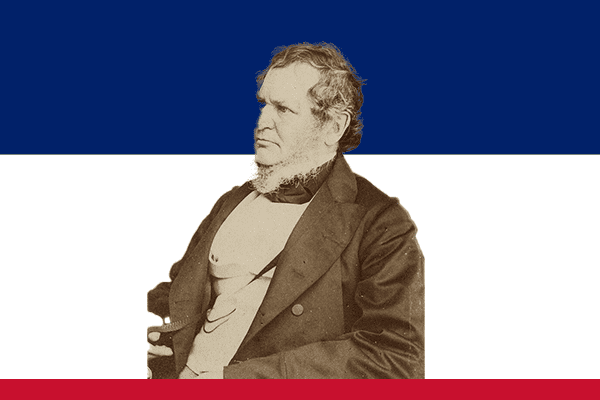
Mr. Edward Smith-Stanley
In Office: 28 June 1866 – 25 February 1868
20 February 1858 – 11 June 1859
Political Party: Conservative
Home State: Knowsley Hall
Lifespan: 1799–1869
Country: United Kingdom
Image credits available here.
Early Life and Political Career
Edward Smith-Stanley was born on 29 March 1799 into an aristocratic British family. He was the son of Edward Smith-Stanley, 13th Earl of Derby and grew up in a political environment that shaped his interest in public affairs. He studied at Christ Church, Oxford, where he received a strong classical education that prepared him for public service.
Stanley entered the Parliament of the United Kingdom in 1820 as a member of the Whig Party. Early in his career he supported moderate political reforms and gained recognition for his ability as a speaker and administrator. Over time, however, he disagreed with some policies of the Whig leadership. These disagreements eventually pushed him to leave the party and move toward Conservative politics. His political shift helped strengthen the Conservative movement during the mid-nineteenth century.
First Term as Prime Minister
Stanley first became Prime Minister in 1852. He formed a minority government under the banner of the Conservative Party. His administration attempted to stabilize the political environment after the fall of the previous government. However, because the Conservatives lacked a strong majority in Parliament, Derby struggled to pass major legislation. His government lasted only a short time before it fell later that year. Despite its brief duration, this first ministry helped reestablish the Conservatives as a significant governing force in British politics.
Second Term as Prime Minister
Derby returned to power in 1858 for his second term as Prime Minister. During this period, his government focused on maintaining political stability and managing relations within the British Empire. One of the most significant events during this administration was the transfer of authority over India from the British East India Company to the British Crown after the Indian Rebellion of 1857. This major constitutional change reshaped imperial governance and placed India under direct control of the British government.
Although Derby’s leadership provided stability during a challenging period, his government again faced difficulties in maintaining parliamentary support. As a result, his second administration ended in 1859.
Third Term and Political Influence
Derby served his third and final term as Prime Minister from 1866 to 1868. During this period, he worked closely with Benjamin Disraeli, a leading Conservative politician who played a major role in government policy. One of the most important achievements of this administration was the passage of the Reform Act 1867. This legislation significantly expanded the voting rights of urban working-class men in Britain. Although Disraeli led much of the parliamentary effort behind the reform, Derby supported the broader political strategy that allowed the Conservatives to carry out this historic change.
Legacy
Edward Smith-Stanley’s political career left a lasting impact on British politics. As leader of the Conservative Party, he helped transform it into a more modern political organization capable of governing during a time of reform. His three terms as Prime Minister demonstrated both the challenges and responsibilities of minority governments in the nineteenth-century parliamentary system.
Historians often remember Derby for his leadership skills, political adaptability, and ability to guide his party through complex political circumstances. His partnership with Benjamin Disraeli also laid the foundation for the future success of Conservative politics in Britain.