Liz Truss
In Office: 6 September 2022 – 25 October 2022
Political Party: Conservative
Home State: Oxford
Lifespan: born 1975
Country: United Kingdom
Image credits available here.
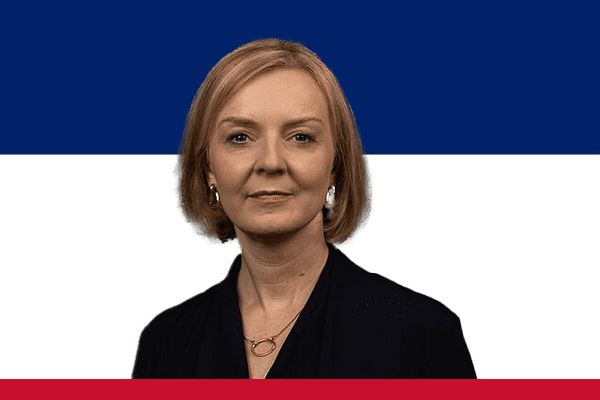
Early Political Career
Mary Elizabeth Truss was born on 26 July 1975 in Oxford, England. She studied Philosophy, Politics and Economics at Merton College, Oxford. After university, she worked in business and later entered politics through the Conservative Party. In 2010, she became the Member of Parliament for South West Norfolk.
Liz Truss quickly rose within the Conservative Party. She earned a reputation for supporting free markets, lower taxes, and smaller government. Former Prime Minister David Cameron appointed her as Environment Secretary in 2014. Later, she served as Justice Secretary and Lord Chancellor under Prime Minister Theresa May. She also worked as Chief Secretary to the Treasury and International Trade Secretary under Prime Minister Boris Johnson. In 2021, she became Foreign Secretary, which increased her popularity among Conservative Party members.
Becoming Prime Minister
Liz Truss became prime minister after Boris Johnson resigned in 2022. The Conservative Party held a leadership contest to choose a new leader. Truss competed against former Chancellor Rishi Sunak. She won the support of party members by promising tax cuts, economic growth, and bold leadership. On 6 September 2022, Queen Elizabeth II formally appointed her as Prime Minister at Balmoral Castle in Scotland. This meeting became historically significant because it was one of the Queen’s last official acts before her death two days later.
Time in Office
As prime minister, Liz Truss aimed to boost the British economy through major tax cuts and deregulation. She appointed Kwasi Kwarteng as Chancellor of the Exchequer. Together, they introduced a “mini-budget” in September 2022. The plan included large unfunded tax cuts and major borrowing.
The financial markets reacted negatively. The value of the British pound fell sharply, and government borrowing costs rose. Investors and economists criticized the plan, saying it created uncertainty and damaged confidence in the economy. The Bank of England had to step in to calm the financial markets. Political pressure increased rapidly within the Conservative Party.
As criticism grew, Truss reversed many of her economic policies. She removed Kwasi Kwarteng and appointed Jeremy Hunt as Chancellor. Hunt cancelled most of the mini-budget proposals. These changes weakened Truss’s authority. Many Conservative MPs lost confidence in her leadership.
Resignation and Legacy
On 20 October 2022, Liz Truss announced her resignation as prime minister. She admitted that she could not deliver the mandate on which she had been elected by the Conservative Party. Her resignation came after only 49 days in office, making her the shortest-serving prime minister in British history. After her departure, Rishi Sunak became the next prime minister.
Liz Truss’s short premiership left a lasting impact on British politics. Her leadership became a symbol of how quickly political authority can collapse when economic confidence disappears. Although her time as prime minister was brief, historians and political analysts continue to study her premiership as a major example of political instability and economic miscalculation in modern Britain.