Margaret Thatcher
In Office: 4 May 1979 – 28 November 1990
Political Party: Conservative
Home State: Grantham
Lifespan: 1925–2013
Country: United Kingdom
Image credits available here.
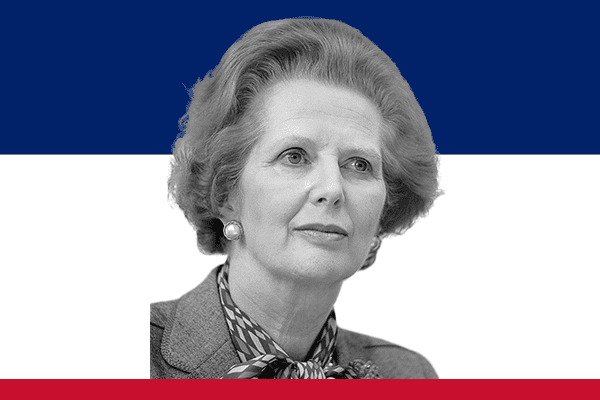
Early Life and Political Career
Margaret Hilda Thatcher was born on 13 October 1925 in Grantham, Lincolnshire, England. She studied chemistry at Oxford University and later trained as a lawyer. From an early age, she showed interest in politics and public service. She joined the Conservative Party and worked hard to rise within its ranks. In 1959, she won election as the Member of Parliament for Finchley. Over the years, she gained a reputation for intelligence, discipline, and confidence. In 1970, Prime Minister Edward Heath appointed her Secretary of State for Education and Science. In 1975, she defeated Heath and became the leader of the Conservative Party. This victory made her the first woman to lead a major British political party.
Prime Minister of the United Kingdom
In the 1979 general election, Margaret Thatcher led the Conservative Party to victory and became Prime Minister. Britain faced serious economic problems at that time, including high inflation, unemployment, and labor unrest. Thatcher believed that strong economic reform could solve these issues. She reduced the role of the state in the economy, cut taxes, controlled public spending, and privatized many state-owned industries. Her government sold companies such as British Gas, British Telecom, and British Airways to private owners. She also reduced the power of trade unions, especially after the miners’ strike of 1984–1985.
Thatcher’s foreign policy also showed strength and determination. In 1982, Argentina invaded the Falkland Islands, a British territory in the South Atlantic. Thatcher responded by sending British forces to retake the islands. Britain’s victory increased her popularity and strengthened her image as a decisive leader. She also worked closely with U.S. President Ronald Reagan and supported strong Western policies during the Cold War. Her anti-communist views and alliance with the United States shaped Britain’s international role.
Legacy and Conclusion
Margaret Thatcher changed Britain in lasting ways. Her supporters believe she modernized the economy, reduced inflation, and restored national confidence. Her critics believe her policies harmed traditional industries and increased inequality. Despite differing opinions, no one can deny her importance in British history. She won three consecutive general elections, which made her the longest-serving British Prime Minister of the twentieth century. In 1990, internal party opposition forced her to resign. Margaret Thatcher died on 8 April 2013 in London. Her legacy remains powerful, and historians continue to debate her achievements and failures. She stands as one of the most influential Prime Ministers the United Kingdom has ever had.