Ranil Wickremesinghe
In Office-Term 1: 12 May 2022 – 21 July 2022
Term 2: 9 December 2001 – 6 April 2004
Term 3: 9 January 2015 – 26 October 2018
Term 4: 16 December 2018 – 21 November 2019
Term 5: 12 May 2022 – 21 July 2022
Political Party: United National Party
Home State: Biyagama
Lifespan: born 1949
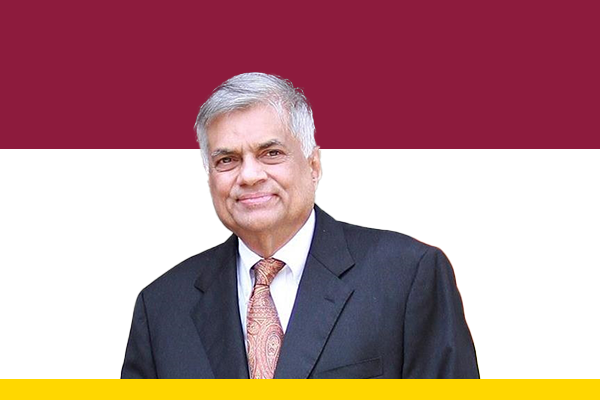
Early Life and Education
Ranil Wickremesinghe, one of Sri Lanka’s most enduring political leaders, was born on March 24, 1949, in Colombo, into an elite political family. His father, Esmond Wickremesinghe, built a reputation as a leading media mogul, while his mother, Nalini Wickremesinghe, came from a prominent political lineage. Ranil studied at Royal College, Colombo, and then earned a law degree from the University of Ceylon. He qualified as an advocate and began his professional career as a lawyer before stepping into politics in the 1970s.
Entry into Politics
Wickremesinghe entered Parliament in 1977 as a member of the United National Party (UNP), under the leadership of President J. R. Jayewardene. At just 28, he took on the role of Deputy Minister of Foreign Affairs. He rapidly moved up the political ranks, later managing major ministerial portfolios such as Youth Affairs, Education, and Industries. He built a reputation for supporting liberal economic reforms, delivering administrative results, and approaching leadership with a technocratic mindset.
Tenure as Prime Minister
Wickremesinghe served multiple terms as Prime Minister—1993–1994, 2001–2004, 2015–2018, briefly in 2018 during a constitutional crisis, and again from 2019 to 2022. He first took office as Prime Minister after the assassination of President Ranasinghe Premadasa and later assumed leadership either after elections or in times of political crisis. Throughout these terms, he pushed to modernize the economy, foster reconciliation, and uphold democratic governance.
During his 2001–2004 term, Wickremesinghe launched peace talks with the LTTE through a Norwegian-brokered ceasefire agreement. Although the ceasefire provided temporary relief, it collapsed under renewed conflict and political resistance. His market-oriented economic reforms also sparked opposition, eventually contributing to the UNP’s electoral loss in 2004.
Presidency in a Time of Crisis
In 2022, widespread protests over Sri Lanka’s worst economic crisis since independence forced President Gotabaya Rajapaksa to resign. Wickremesinghe, then serving as Prime Minister, stepped in as acting president and later won parliamentary election to the presidency in July 2022.
He took charge amid severe shortages of essentials like fuel, food, and medicine. Wickremesinghe imposed tough fiscal reforms and successfully negotiated an IMF bailout to stabilize the collapsing economy. While many praised his economic management, critics condemned his association with the previous administration and his crackdowns on public protests.
Political Style and Leadership
Wickremesinghe has consistently displayed an intellectual, diplomatic style, favoring policy expertise over populism. He has shown resilience in navigating minority governments and fragile coalitions. His strong belief in free-market principles, international cooperation, and governance reform has defined much of his leadership.
Legacy
Ranil Wickremesinghe has spent over four decades in active politics, making him one of Sri Lanka’s most experienced political figures. As he continues to lead the nation through economic recovery, his full legacy remains in formation. Whether history will remember him as a reformer, a crisis manager, or a political survivor, his influence on modern Sri Lanka is both significant and lasting.