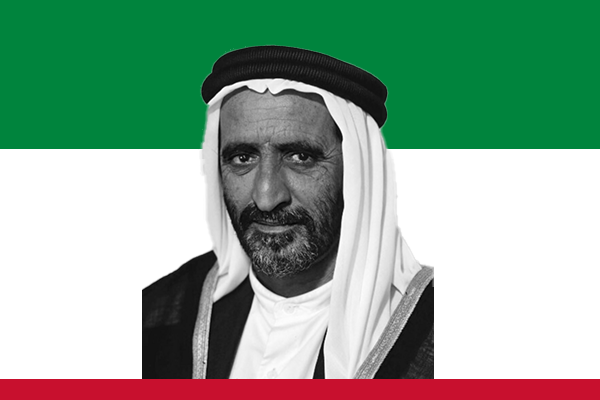
Mr. Rashid bin Saeed Al Maktoum
In Office: 30 April 1979 – 7 October 1990
Political Party: Emblem of the United Arab Emirates
Home State: Dubai
Lifespan: 1912–1990
Country: United Arab Emirates
Image credits available here.
Early Life and Rise to Leadership
Rashid bin Saeed Al Maktoum was born in 1912 into the Al Maktoum family, the ruling family of Dubai. From an early age, he received traditional education and training in leadership, governance, and Islamic values. These formative experiences prepared him to take on responsibilities at a young age. In 1958, he became the Ruler of Dubai, assuming leadership at a time when the region faced limited resources and uncertain economic prospects. Rather than accepting constraints, he viewed them as challenges to overcome through planning and innovation.
Role in the Formation of the UAE
Rashid bin Saeed Al Maktoum played a central role in the creation of the United Arab Emirates in 1971. He worked closely with Sheikh Zayed bin Sultan Al Nahyan to unite the emirates into a single federal state. His commitment to cooperation and consensus proved vital during negotiations that shaped the new nation. Following independence, he served as Vice President and Prime Minister of the UAE, positions he held until his death in 1990. In these roles, he helped establish federal institutions, administrative systems, and policies that balanced national unity with the autonomy of individual emirates.
Visionary Leadership and Economic Development
As Prime Minister and Ruler of Dubai, Rashid bin Saeed Al Maktoum demonstrated remarkable economic foresight. He believed that infrastructure and trade would drive long-term growth. Under his leadership, Dubai invested heavily in ports, roads, airports, and public services. Projects such as the expansion of Port Rashid and the development of Jebel Ali Port reflected his belief that commerce and connectivity were essential for success.
Importantly, he pursued diversification long before oil revenues peaked. While oil income supported development, he ensured that Dubai did not depend solely on natural resources. This strategy encouraged trade, tourism, and services, setting Dubai on a sustainable economic path.
Governance Style and Administrative Reforms
Rashid bin Saeed Al Maktoum led with a practical and results-oriented approach. He valued efficiency, accountability, and long-term planning. As Prime Minister, he supported the creation of strong federal ministries while respecting local governance structures. His leadership style emphasized consultation, drawing on advice from experts and trusted advisors while maintaining decisive authority.
He also prioritized social development. Investments in education, healthcare, and housing improved the quality of life for citizens and residents alike. These policies helped create social stability during a period of rapid change.
Legacy and Lasting Impact
The legacy of Prime Minister Rashid bin Saeed Al Maktoum remains deeply embedded in the UAE’s success story. His vision transformed Dubai into a regional hub and contributed to the strength of the federal system. Many of the principles he championed—economic diversification, infrastructure-led growth, and cooperative governance—continue to guide national policy today.