Mr. Raymond Barre
In Office: 25 August 1976 – 21 May 1981
Political party: Union for French Democracy
Home State: Saint-Denis
Lifespan: 1924–2007
Country: France
Image credits available here.
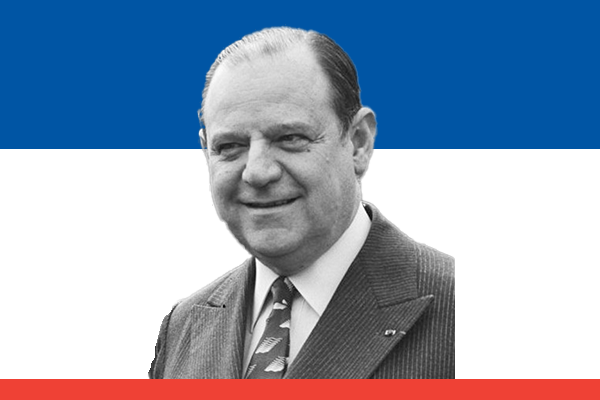
Early Life and Education
Raymond Barre was born on April 12, 1924, in Saint-Denis, Réunion. He grew up in a modest family and developed a strong interest in economics during his early education. He pursued higher studies in Paris, where he attended the prestigious Institut d’Études Politiques and later the École Nationale d’Administration (ENA). These institutions trained him in public administration and economics, giving him the foundation for his future political and academic career.
Academic and Professional Career
Before entering politics, Barre built his reputation as a respected economist. He taught at the University of Paris and gained recognition for his expertise in international economics. The French government appointed him as Vice President of the European Commission in 1967, where he played a vital role in shaping European economic policy. His tenure in Brussels enhanced his knowledge of economic cooperation and integration, which he later applied as France’s Prime Minister.
Appointment as Prime Minister
President Valéry Giscard d’Estaing appointed Raymond Barre as Prime Minister in August 1976 after the resignation of Jacques Chirac. Barre accepted the challenge during a period of global economic turbulence caused by the oil crisis and rising inflation. Unlike many of his predecessors, Barre was not a career politician but a technocrat. The president chose him because of his ability to implement tough but necessary economic reforms.
Economic Policies and Reforms
As Prime Minister, Barre introduced a series of economic measures that became known as the “Barre Plans.” He reduced inflation by tightening public spending and controlling wages. He encouraged investment and worked to stabilize the French franc. Although many citizens initially criticized his austerity policies, he believed these measures would secure long-term stability. His government also emphasized modernization and competitiveness in industry.
Barre promoted free-market principles while balancing them with social responsibilities. He strengthened ties with European partners and pushed for deeper cooperation within the European Community. His economic strategies earned him respect among financial experts, even though they sometimes made him unpopular with ordinary French citizens.
Domestic Challenges
Barre faced strong opposition from trade unions and left-wing parties, who argued that his policies increased unemployment and hurt working-class families. Despite these criticisms, he defended his reforms and insisted they were essential for France’s economic recovery. His calm and intellectual style contrasted with the more charismatic approach of other French leaders, which made it difficult for him to connect with the broader public.
International Relations
On the international stage, Barre maintained France’s active role in Europe and global affairs. He supported European integration and worked closely with West Germany to strengthen the European Community. His government also navigated Cold War tensions while upholding France’s independent foreign policy. He valued diplomacy and believed that cooperation among European nations would bring long-term stability and prosperity.
Later Career and Legacy
After leaving the office of Prime Minister in 1981, Barre continued to influence French politics. He ran as a candidate in the 1988 presidential election, where he positioned himself as a centrist alternative, but he did not win. Despite the defeat, his reputation as a principled economist and statesman remained intact. He later served as a member of the French National Assembly and the mayor of Lyon.
Raymond Barre passed away on August 25, 2007, in Paris. Many remembered him as an intellectual leader who prioritized reason over rhetoric. His economic reforms left a lasting impact on French financial policy and contributed to the foundation of a stronger European economy.
Conclusion
Raymond Barre stood out among French leaders because of his expertise in economics and his commitment to stability. As Prime Minister, he faced immense challenges but pursued reforms with determination. Although his austerity measures drew criticism, they reflected his belief in long-term economic discipline. Today, historians regard Barre as a leader who bridged academic knowledge with political responsibility, leaving a legacy of integrity and vision.