Theresa May
In Office: 13 July 2016 – 24 July 2019
Political Party: Conservative
Home State: Marylebone
Lifespan: born 1956
Country: United Kingdom
Image credits available here.
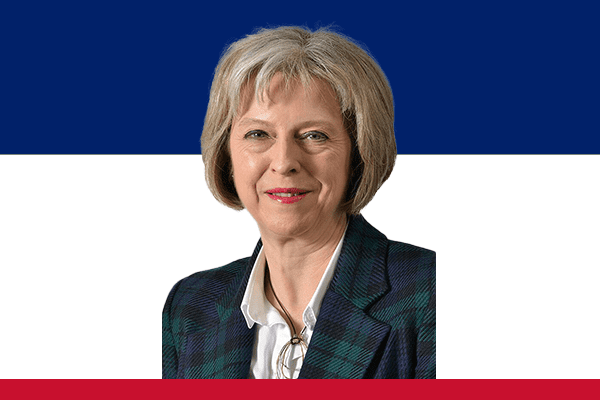
Early Life and Political Roots
Theresa Mary May grew up in Oxfordshire, England. She attended the University of Oxford, where she studied geography and developed an early interest in public service. After graduating, she worked in financial services before entering politics. May built her reputation as a thoughtful and disciplined politician. In 1997, she won election as the Member of Parliament for Maidenhead. She proved herself a committed constituency representative and a voice of steady judgment in Parliament.
Rise Through the Ranks
May rose steadily in the Conservative Party. In 2002, she joined the shadow cabinet, where she tackled transport and local government issues. When the Conservative Party won the 2010 general election, May entered government as Home Secretary, the first woman to hold that post in nearly fifty years. As Home Secretary from 2010 to 2016, she focused on reforming the police, tightening immigration controls, and strengthening national security. She built a reputation for meticulous attention to detail and fierce advocacy for law and order.
Taking the Helm: Prime Minister
After the Brexit referendum in June 2016, in which the United Kingdom voted to leave the European Union, David Cameron resigned as prime minister. Theresa May won the Conservative Party leadership contest and became the country’s second female prime minister. From the beginning, she set a clear objective: deliver the result of the referendum while minimizing economic disruption and preserving Britain’s global standing.
May made early decisions that defined her premiership. She triggered Article 50 of the Treaty on European Union in March 2017, formally beginning the two‑year withdrawal process. She also called a snap general election for June 2017, seeking a stronger mandate. Instead, she lost her party’s majority in the House of Commons. May then led a minority government supported by the Democratic Unionist Party (DUP), requiring constant negotiation to pass legislation.
Brexit Negotiations: Determination Under Pressure
Theresa May committed herself to securing a Brexit deal that Parliament could approve. She negotiated extensively with European Union leaders, striving to protect jobs, maintain security cooperation, and smooth the transition. Her government reached an agreement with the EU in November 2018. However, many members of Parliament rejected the deal several times, arguing that the terms either threatened the UK’s economic future or betrayed the referendum result.
May held firm amid fierce criticism from both Brexit hardliners and Remain supporters. She worked tirelessly to adjust her proposals, reaching out to opposition parties and reshaping her strategy to win support. Despite her persistence, Parliament repeatedly defeated her agreement, and divisions deepened across British politics.
Leadership Challenges and Resignation
As pressure mounted, Theresa May faced calls from within her own party to step aside. She refused for months, believing that abandoning the negotiations would betray voters. Nevertheless, after failing to secure approval for her Brexit plan, she announced her resignation as Conservative Party leader in May 2019. She remained prime minister until her successor, Boris Johnson, took office in July 2019.
Legacy and Impact
Theresa May’s legacy proves complex and significant. She demonstrated unyielding dedication to democratic choice and national service. She strengthened domestic policies on mental health, modern slavery, and equal pay, championing measures that improved public welfare. May also emphasized national security, authorizing increased investment in the armed forces and counter‑terrorism efforts.
Even critics acknowledge her commitment to principle and her resilience in the face of political adversity. Her tenure underscored the difficulties inherent in managing deep political divisions while leading a parliamentary democracy.
Life After Downing Street
After leaving the premiership, Theresa May returned to the backbenches in Parliament. She continued to speak on national issues, offering insight drawn from her years in leadership. May balances her public duties with time spent with her family, reflecting on a career marked by service and fortitude.