Mr. Wen Jiabao
In Office: 16 March 2003 – 14 March 2013
Political Party: Chinese Community Party
Home State: Tianjin
Lifespan: 1942–?
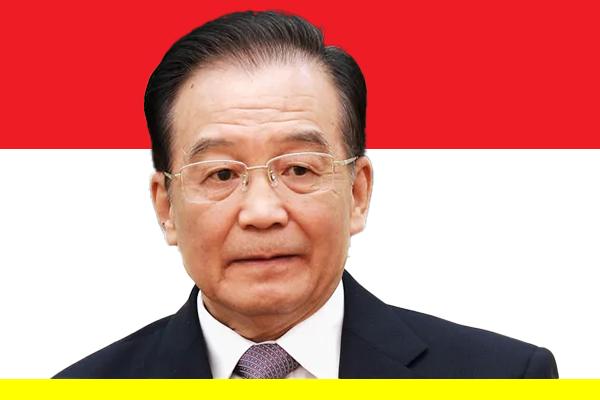
Early Life and Education
Wen Jiabao was born on September 15, 1942, in Tianjin, China, into a modest family background. His childhood coincided with significant political and social upheaval in China. Wen pursued higher education at the Beijing Institute of Geology (now China University of Geosciences), graduating in 1968 with a degree in geology. He spent the early part of his career as a geologist before gradually transitioning into political and administrative roles within the Chinese Communist Party (CCP).
Political Ascent
Wen rose through the party ranks during the 1980s, working closely with reformist leaders such as Zhao Ziyang and Hu Yaobang. His survival through the political purges that followed the 1989 Tiananmen Square protests highlighted his political caution and adaptability. In 1998, Wen was appointed Vice Premier, and by 2003, he succeeded Zhu Rongji to become the sixth Premier of the People’s Republic of China.
Premier of China (2003–2013)
Wen Jiabao served as Premier for two five-year terms, from 2003 to 2013. During this period, China experienced rapid economic growth, increasing its influence on the global stage. While continuing with the economic reforms initiated by his predecessors, Wen focused on reducing social inequality and improving the welfare of ordinary citizens. His administration promoted balanced development under the banner of building a “harmonious society.”
Domestic Policies and Social Reforms
As Premier, Wen prioritized the rural population, healthcare, education, and poverty alleviation. He increased funding for rural schools, expanded access to public health services, and initiated social security reforms. Wen sought to narrow the income gap and bring more equitable development to China’s vast interior regions, reflecting his deep concern for social justice.
Crisis Management and Public Image
Wen Jiabao demonstrated strong leadership during national crises. His empathetic and hands-on response to the 2008 Sichuan earthquake earned him public admiration. He was also instrumental in managing China’s response to the 2008 global financial crisis, launching a massive economic stimulus plan that focused on infrastructure investment and boosting domestic consumption.
Known affectionately as “Grandpa Wen” by many Chinese citizens, he cultivated an image of a kind, approachable, and humble leader. He often visited disaster sites, schools, and poor villages, engaging with citizens in a personal manner rarely seen among top officials.
Controversy and Retirement
In the final year of his premiership, Wen’s family came under scrutiny for reportedly amassing vast wealth, as detailed in a 2012 New York Times investigation. Though Wen denied involvement and the Chinese government censored the report domestically, the allegations marred his otherwise popular image.
He stepped down in 2013 and was succeeded by Li Keqiang.
Legacy
Wen Jiabao is remembered as a compassionate and reform-minded leader who prioritized the needs of China’s poor and working-class citizens. Despite controversies, his decade in office is viewed as a period of relative openness, social investment, and human-centered governance. His legacy continues to shape discussions around social justice and inclusive development in modern China.