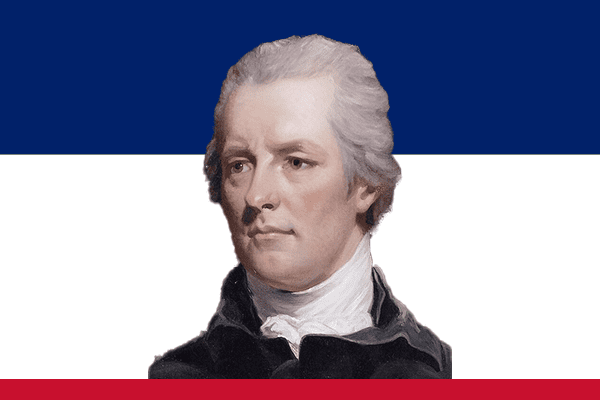
Mr. William Pitt the Younger
In Office: 10 May 1804 – 23 January 1806
1 January 1801 – 14 March 1801
Political Party: Tory
Home State: Hayes, Bromley
Lifespan: 1759–1806
Country: United Kingdom
Image credits available here.
Early Life and Education
William Pitt the Younger was born on 28 May 1759 in Hayes, Kent. His father, William Pitt the Elder, had already served as Prime Minister of Britain and was widely respected for his political leadership. Pitt received a strong education at home because of his delicate health during childhood. Later, he studied at University of Cambridge, where he developed exceptional skills in debate, economics, and political theory.
Pitt entered politics at a young age and became a Member of Parliament in 1781. His intelligence, discipline, and strong speaking abilities quickly earned him recognition in Parliament.
Becoming the Youngest Prime Minister
In 1783, political instability created an opportunity for Pitt to rise to power. King George III appointed Pitt as Prime Minister when he was only 24 years old. Many critics doubted his ability to lead such an important government due to his youth. However, Pitt quickly proved his capability through strong leadership and effective reforms.
Pitt worked to stabilize Britain’s economy, which had suffered after the American Revolutionary War. He introduced financial reforms that improved taxation and reduced national debt. The Sinking Fund was established to gradually pay off Britain’s debt.
Domestic Reforms and Policies
Several reforms were introduced by Pitt to improve the efficiency of the British government. Trade regulations were simplified, and efforts were made to reduce corruption in public administration. Pitt also supported free trade policies and negotiated the Eden Treaty with France, which encouraged trade between the two countries.
Although Pitt supported moderate parliamentary reform, many of his proposals faced strong opposition. Political tensions increased in Britain after the outbreak of the French Revolution in 1789. Concerns about revolutionary ideas spreading to Britain led Pitt to adopt stricter security measures.
Leadership During War with France
Pitt played a crucial role during Britain’s conflicts with revolutionary and Napoleonic France. Britain joined European coalitions to oppose the expansion of Napoleon Bonaparte. Pitt worked to strengthen Britain’s military and naval power while also organizing alliances with other European nations.
His government imposed new taxes and financial measures to support the war effort. Despite economic challenges, Pitt successfully maintained Britain’s resistance against French dominance in Europe.
Later Career and Death
Pitt resigned briefly in 1801 because of disagreements with King George III over the issue of Catholic emancipation in Ireland. However, he returned as Prime Minister in 1804 when the war against Napoleon intensified.
Pitt’s health declined due to the pressures of leadership and continuous war. He died on 23 January 1806 at the age of 46. His death marked the end of a remarkable political career.
Legacy
William Pitt the Younger left a lasting impact on British politics and financial administration. His reforms strengthened Britain’s economic system and helped the country withstand the pressures of war. Historians often regard him as one of the most capable Prime Ministers of the late eighteenth and early nineteenth centuries.