Mr. Calvin Coolidge
In Office: March 4, 1921 – August 2, 1923
Political Party: Republican
Home State: Vermont
Lifespan: 1872–1933
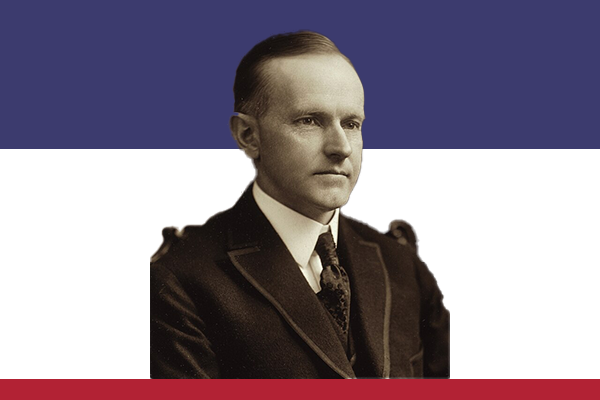
Calvin Coolidge (1872–1933), the 29th President of the United States, served from 1921 to 1923 during a period of rapid economic growth and social transformation known as the “Roaring Twenties.” Known for his honesty, restraint, and firm belief in limited government, Coolidge remains a symbol of traditional American conservatism. While often characterized as quiet and reserved, he was a sharp political thinker who left a lasting impression on the presidency and American political culture.
Early Life and Education
John Calvin Coolidge Jr. was born on July 4, 1872, in Plymouth Notch, Vermont. He is the only U.S. president born on Independence Day. His father was a local storekeeper, farmer, and public official, and young Calvin was raised with strong values of thrift, discipline, and duty.
Coolidge attended Amherst College in Massachusetts, graduating in 1895. After reading law, he was admitted to the bar and began practicing in Northampton, Massachusetts. His legal work and reputation for integrity helped him build connections in local politics.
Political Rise
Coolidge’s political career advanced steadily through the Massachusetts state government. He served as city councilman, mayor of Northampton, state legislator, and eventually president of the state Senate. In 1918, he was elected governor of Massachusetts.
Coolidge gained national fame in 1919 during the Boston Police Strike, when he refused to reinstate striking police officers, declaring, “There is no right to strike against the public safety by anybody, anywhere, anytime.” His firm stance earned him praise from conservatives and business leaders and helped secure his nomination as vice president on the Republican ticket in 1920 alongside Warren G. Harding.
Vice Presidency and Sudden Presidency
Harding and Coolidge won a landslide victory in the 1920 election. Coolidge served quietly and loyally as Vice President, rarely making headlines. That changed abruptly on August 2, 1923, when President Harding died unexpectedly while on a speaking tour. Coolidge, visiting his family home in Vermont, took the presidential oath of office by lamplight from his father, a notary public.
Coolidge inherited a scandal-ridden administration. The Teapot Dome scandal and other instances of corruption had tainted Harding’s presidency. Coolidge quickly took steps to restore public trust by cooperating with investigations, removing corrupt officials, and emphasizing transparency.
Presidency (1923–1929)
Coolidge was elected in his own right in 1924, defeating Democrat John W. Davis and Progressive Robert M. La Follette. His campaign slogan, “Keep Cool with Coolidge,” reflected his calm demeanor and commitment to stability.
Coolidge governed with a philosophy of small government, low taxes, and minimal regulation. He believed that prosperity came from the private sector, not government programs. Under his administration, the U.S. economy boomed: unemployment remained low, wages rose, and industrial production surged.
He signed the Revenue Acts of 1924 and 1926, which cut taxes and helped generate budget surpluses. He also vetoed bills he considered wasteful or unconstitutional, including farm relief measures and bonuses for World War I veterans. His use of the presidential veto was frequent and firm.
Coolidge was a staunch supporter of business, famously stating, “The chief business of the American people is business.” However, he was cautious in foreign policy, avoiding entanglements while supporting international disarmament efforts such as the Kellogg–Briand Pact of 1928, which renounced war as a tool of national policy.
Style and Personality
Coolidge earned the nickname “Silent Cal” for his quiet demeanor and economy of words. His dry wit became legendary. At social functions, he often spoke little, and stories abound of his monosyllabic responses. Yet he was not aloof—he had a deep respect for tradition, the Constitution, and the responsibilities of his office. He was also the first president to make widespread use of radio to speak directly to the American people, giving over a dozen radio addresses during his presidency.
Later Life and Death
In 1928, at the height of his popularity, Coolidge surprised the nation by choosing not to seek another term, stating simply, “I do not choose to run.” He returned to private life in Northampton, where he wrote a widely read autobiography and contributed articles to magazines. Coolidge died suddenly of a heart attack on January 5, 1933, at the age of 60.
Legacy
Historians remain divided on Coolidge’s legacy. Supporters praise his fiscal responsibility, honesty, and devotion to constitutional principles. Critics argue that his policies failed to address growing income inequality and financial speculation, which helped lead to the Great Depression shortly after he left office. Still, Coolidge is remembered as a president who provided steady leadership, restored dignity to the White House after scandal, and embodied a philosophy of limited government that continues to influence conservative thought to this day.