Mr. Chester A. Arthur
In Office: March 4, 1881 – September 19, 1881
Political Party: Republican
Home State: Fairfield
Lifespan: 1829–1886
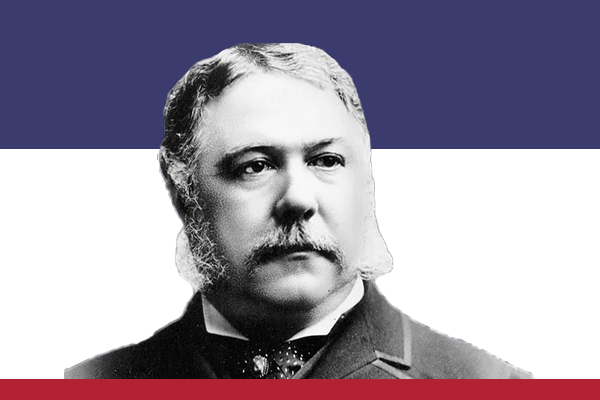
Early Life and Political Background
Born on October 5, 1829, in Fairfield, Vermont, Chester A. Arthur grew up in upstate New York. A graduate of Union College, he worked as a lawyer before entering politics. Arthur gained prominence as a member of the New York Republican political machine, closely aligned with Senator Roscoe Conkling and the Stalwart faction, which defended the spoils system.
Arthur served as the Collector of the Port of New York, one of the most powerful patronage positions of the era, before being removed by President Rutherford B. Hayes for alleged corruption and cronyism. Despite this, he retained strong party backing, especially among machine politicians.
Chester A. Arthur as Vice President
Election of 1880
In the fiercely divided Republican National Convention of 1880, a compromise was needed to unite the party’s factions. The convention ultimately nominated James A. Garfield, a Half-Breed moderate, for President, and paired him with Chester A. Arthur, a Stalwart loyalist, as a political balance.
The Garfield-Arthur ticket defeated Democratic nominee Winfield Scott Hancock in the general election.
Vice Presidency (March 4 – September 19, 1881)
Chester A. Arthur served only 199 days as Vice President, one of the shortest tenures in U.S. history. During this time:
He presided over the Senate but had little influence on executive decisions.
He maintained loyalty to Conkling and the Stalwarts, even amid fierce internal party battles over federal appointments.
His position put him at odds with President Garfield, who supported civil service reform and opposed patronage-based appointments.
Arthur’s limited engagement as Vice President led many to view him as politically ornamental, not a policymaker.
Ascension to the Presidency
On July 2, 1881, President Garfield was shot by Charles J. Guiteau, a disgruntled office seeker who claimed to act on behalf of the Stalwart faction. Although Arthur had no connection to the assassin, suspicion and fear surrounded his political allies.
When Garfield died on September 19, 1881, Arthur was sworn in as President of the United States. Many Americans feared the rise of machine politics, but Arthur surprised them with a moderate and reformist presidency.
Legacy of Arthur’s Vice Presidency
While Arthur’s vice presidency was brief and largely uneventful in terms of legislation or national leadership, it played a crucial role in:
Uniting Republican factions in a divided election
Positioning him for the presidency during a national crisis
Demonstrating the unpredictable nature of political succession
His transformation from party loyalist to principled reformer stands as one of the most surprising shifts in presidential history.