Mr. Dick Cheney
In Office: January 20, 2001 – January 20, 2009
Political Party: Republican
Home State: Lincoln
Lifespan: Born–1941
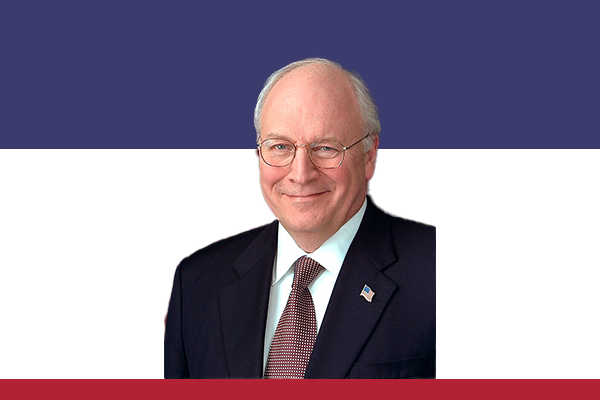
Dick Cheney (born 1941) served as the 46th Vice President of the United States from 2001 to 2009 under President George W. Bush. A highly experienced and influential figure in American politics, Cheney is best known for his strong stance on national security, his role in shaping U.S. foreign policy during the War on Terror, and his controversial advocacy for expanded executive power. His career spanned decades and included high-ranking roles in government, business, and defense policy.
Early Life and Education
Richard Bruce Cheney was born on January 30, 1941, in Lincoln, Nebraska. He grew up in Casper, Wyoming, where his father worked for the U.S. Department of Agriculture. Cheney attended Yale University, but he struggled academically and dropped out. He later earned both his bachelor’s and master’s degrees in political science from the University of Wyoming.
In his early twenties, Cheney faced several draft deferments during the Vietnam War, which became a point of political criticism later in his career. He married Lynne Vincent in 1964. They had two daughters, including Liz Cheney, who later became a U.S. Representative from Wyoming.
Entry into Politics
Cheney began his political career as an intern and staffer in Washington, D.C., working under Donald Rumsfeld in the Nixon and Ford administrations. When Gerald Ford became president in 1974, Cheney served as White House Chief of Staff from 1975 to 1977. At age 34, he was the youngest person ever to hold that position at the time.
Congressional Career
In 1978, Cheney returned to Wyoming and won election to the U.S. House of Representatives, where he served for ten years. He was known as a reliable conservative and was respected by colleagues on both sides of the aisle. During his time in Congress, he rose to House Minority Whip, the second-highest Republican leadership position. He voted consistently in favor of conservative economic and defense policies. Though not flashy, he was considered a serious and disciplined legislator.
Secretary of Defense (1989–1993)
President George H. W. Bush appointed Cheney as Secretary of Defense in 1989. In that role, he oversaw the U.S. military during the Gulf War in 1991. Under his leadership, the U.S.-led coalition quickly expelled Iraqi forces from Kuwait with minimal American casualties. The war was seen as a major success and raised Cheney’s public profile. During his tenure, he also managed post-Cold War military downsizing and made significant budget decisions. He left office in 1993 with high approval ratings and a reputation as a competent and steady defense leader.
Private Sector Work
After leaving government, Cheney became CEO of Halliburton, a multinational oil services company, from 1995 to 2000. His time at Halliburton was lucrative but controversial. Critics later accused him of helping the company gain government contracts during his vice presidency. Cheney denied any wrongdoing.
Vice Presidency (2001–2009)
In 2000, Texas Governor George W. Bush chose Cheney to lead his vice-presidential search committee—only for Cheney to become the nominee himself. The Bush-Cheney ticket won the 2000 election, although it was one of the closest and most disputed races in U.S. history, ultimately decided by the Supreme Court. Cheney became one of the most powerful vice presidents in U.S. history. After the 9/11 terrorist attacks, Cheney played a central role in shaping the U.S. response. He advocated for:
The invasion of Afghanistan to remove the Taliban and pursue al-Qaeda
The invasion of Iraq in 2003, based on claims that Saddam Hussein had weapons of mass destruction
Enhanced interrogation techniques, which many critics call torture
Warrantless surveillance and expanded intelligence powers
Cheney strongly supported expanding the powers of the presidency, often citing national security concerns. He also influenced energy policy and pushed for secrecy in decision-making. His role earned him both praise for his decisiveness and criticism for undermining democratic transparency. He survived multiple heart attacks during his vice presidency and often had to manage his duties while dealing with serious health problems.
Post-Vice Presidency and Legacy
After leaving office in 2009, Cheney remained a vocal defender of the Bush administration’s national security policies. He published a memoir, In My Time, in 2011, offering his perspective on the controversies he faced. Over time, opinions about Cheney became more complex. Many on the right admired his toughness and consistency, while critics on the left condemned his role in the Iraq War and torture program. His approval ratings remained low after leaving office, but some later viewed his steadfastness as a form of political courage. In recent years, Cheney supported his daughter Liz Cheney, who became known for her criticism of former President Donald Trump and defense of democratic norms. Though Cheney rarely appeared in public, his influence on national security policy remains evident.
Conclusion
Dick Cheney’s career was defined by power, controversy, and conviction. As Vice President, he reshaped the office into one of unprecedented influence. His legacy includes bold, often divisive, actions during a critical time in U.S. history—particularly in the wake of 9/11 and the War on Terror. Whether viewed as a patriot or a power broker, Cheney left an indelible mark on American politics.
Ask ChatGPT