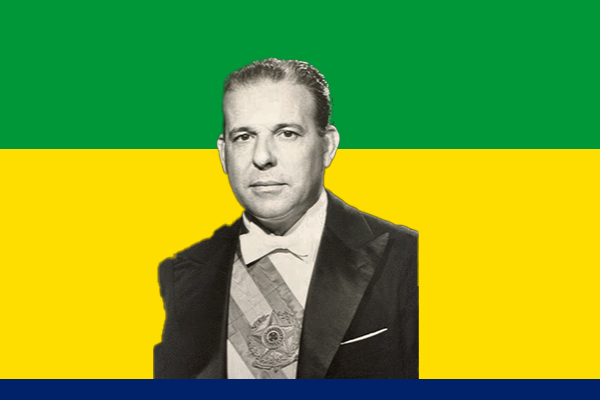
Early Life and Political Rise
João Goulart, born on March 1, 1919, in Rio Grande do Sul, grew up in a family that valued hard work and public service. He pursued law at the Federal University of Rio Grande do Sul, where he developed a strong interest in social justice and political equality. Goulart entered politics in the 1940s, joining the Brazilian Labour Party (PTB). His dedication to improving workers’ rights and reducing inequality quickly earned him recognition within the party and among the Brazilian people.
When Getúlio Vargas, the influential leader of Brazil, noticed Goulart’s political potential, he appointed him as Minister of Labor in 1953. Goulart actively introduced reforms to improve the minimum wage and working conditions. His policies gained strong support from the working class but faced opposition from business elites. Despite criticism, Goulart continued to fight for labor rights, believing that a fair economy required social justice.
Role as Vice President
In 1956, João Goulart was elected Vice President under President Juscelino Kubitschek. He played a key role in strengthening communication between the government and the people. Goulart traveled across Brazil to understand the challenges faced by ordinary citizens and worked closely with labor unions to advocate for fair economic policies. His active involvement in politics helped him gain popularity among workers and peasants, though conservatives often accused him of promoting leftist ideas.
During Jânio Quadros’ presidency in 1960, Goulart again won the vice presidency, demonstrating his enduring public appeal. When Quadros suddenly resigned in 1961, Goulart faced political turmoil. Conservative military leaders attempted to block his succession, fearing his reformist agenda. However, the Brazilian people rallied in his support. Goulart negotiated with Congress and military officials to assume office under a parliamentary system that limited his powers temporarily. His calm and diplomatic approach helped Brazil avoid a potential civil conflict.
Leadership and Reforms
As Vice President and later as President, João Goulart actively pursued reforms aimed at social and economic transformation. He promoted the “Basic Reforms Plan,” which focused on land redistribution, education, and tax changes to reduce inequality. Goulart encouraged investment in public education and supported rural workers seeking land rights. His government also aimed to nationalize key industries to protect Brazilian resources from foreign control.
Goulart believed in democratic governance and sought to balance economic growth with social welfare. He held discussions with both labor leaders and business owners to find solutions that could benefit all sectors. However, his progressive ideas met strong resistance from conservative politicians, the elite, and the military, who feared his policies leaned toward socialism.
Political Challenges and Legacy
Political tensions deepened in the early 1960s as inflation rose and opposition groups accused Goulart of destabilizing the economy. Despite mounting pressure, he continued to defend his reformist agenda, emphasizing that social justice was essential for lasting national stability. In 1964, a military coup forced him out of power, ending Brazil’s democratic rule for two decades.
Even after his exile, Goulart remained a symbol of democracy and social equality. He lived in Argentina and Uruguay, where he continued advocating for Brazil’s return to democratic governance. He passed away in 1976, but his influence persisted in Brazil’s political consciousness.
Conclusion
Vice President João Goulart actively shaped Brazil’s political and social landscape through his tireless advocacy for labor rights, democratic values, and equitable reforms. His courage in confronting political opposition and his vision for a fairer society inspired generations of Brazilians. Goulart’s legacy continues to remind Brazil of the importance of democracy, reform, and compassion in leadership.