Mr. Mike Pence
In Office: January 20, 2017 – January 20, 2021
Political Party: Republican
Home State: Columbus, Indiana
Lifespan: Born–1959
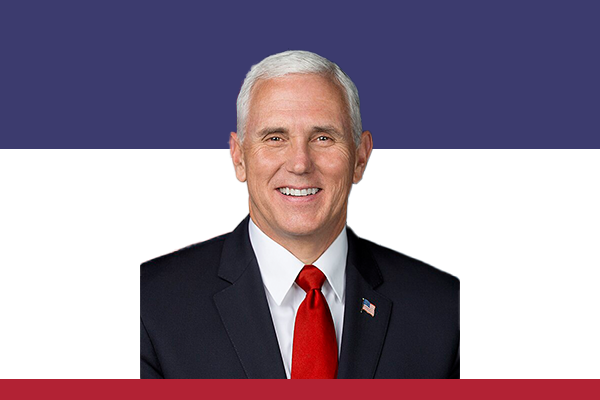
Michael Richard Pence, known as Mike Pence, is an American politician, lawyer, and broadcaster who served as the 48th Vice President of the United States from 2017 to 2021 under President Donald J. Trump. Prior to that, he was the Governor of Indiana and a long-serving member of the U.S. House of Representatives. Known for his firm conservative principles and calm demeanor, Pence has been a significant figure in modern American Republican politics.
Early Life and Education
Mike Pence was born on June 7, 1959, in Columbus, Indiana, to a Catholic family of Irish descent. He was one of six children. His father, Edward Pence, served in the U.S. Army during the Korean War and later ran a gas station. Pence grew up idolizing Democratic figures like John F. Kennedy but shifted politically in college after becoming a born-again evangelical Christian. He attended Hanover College, earning a degree in history in 1981, and received his J.D. from the Indiana University Robert H. McKinney School of Law in 1986.
Early Career and Entry into Politics
Before entering public office, Pence worked as an attorney and later hosted a conservative talk radio show called “The Mike Pence Show,” which helped build his profile in Indiana. He described himself as “a Christian, a conservative, and a Republican, in that order.” He ran unsuccessfully for Congress in 1988 and 1990 but gained recognition for his articulate communication style and dedication to conservative ideals. In 2000, Pence won a seat in the U.S. House of Representatives, beginning a 12-year career in Congress.
Congressional Career (2001–2013)
As a Congressman representing Indiana’s 2nd and later 6th congressional districts, Pence developed a reputation as a principled conservative. He opposed excessive government spending, abortion, and same-sex marriage, while supporting tax cuts, strong national defense, and free-market policies. He was a key figure in the Tea Party movement and often challenged Republican leadership on issues of fiscal discipline and government transparency. Pence served as chairman of the House Republican Conference, the third-highest position in the House GOP, from 2009 to 2011.
Governor of Indiana (2013–2017)
In 2012, Pence was elected the 50th Governor of Indiana. His term was marked by both conservative reforms and controversy. His administration focused on:
Tax cuts for individuals and businesses.
Expansion of school choice and charter schools.
Job creation and economic development.
However, he faced national backlash in 2015 after signing the Religious Freedom Restoration Act (RFRA), which critics argued allowed businesses to discriminate against LGBTQ individuals. Pence later signed a revision to clarify that the law did not permit discrimination, but the controversy damaged his national image. Despite the backlash, Pence retained strong support among social conservatives, making him an appealing vice-presidential candidate.
Vice Presidency (2017–2021)
In July 2016, Donald Trump selected Pence as his running mate to help balance the ticket with an experienced, traditional conservative. The Trump-Pence ticket won the 2016 election, and Pence was sworn in as Vice President on January 20, 2017.
As Vice President, Pence played a key role in:
Liaising with Congress to help pass tax reform in 2017.
Leading the administration’s COVID-19 Task Force in 2020.
Supporting Trump’s judicial nominations, including three Supreme Court justices.
Maintaining strong ties with the evangelical Christian community.
Pence remained fiercely loyal to Trump through most of the administration. However, their relationship fractured following the 2020 presidential election.
January 6th and Political Fallout
After Trump lost the 2020 election to Joe Biden, he pressured Pence to overturn the Electoral College results during the January 6, 2021, congressional certification. Pence, citing constitutional constraints, refused. On that day, rioters stormed the U.S. Capitol, with some chanting threats against Pence.
Despite intense pressure, Pence returned to the Senate chamber after the riot and presided over the certification of Biden’s victory. This act was widely praised across the political spectrum as a commitment to the Constitution and democratic norms but led to a rift with Trump and parts of the Republican base.
2024 Presidential Campaign and Later Career
In 2023, Mike Pence announced a run for the 2024 Republican presidential nomination, positioning himself as a traditional conservative alternative to Trump. He emphasized restoring civility, the rule of law, and a return to Reagan-era Republican values. However, he struggled to gain traction in a party still largely loyal to Trump and suspended his campaign in late 2023. Since then, Pence has remained active in conservative policy circles, writing, speaking, and advocating for religious liberty, national defense, and constitutional governance.
Personal Life
Mike Pence has been married to Karen Pence since 1985, and they have three children. Known for his strong religious beliefs, he openly discusses his Christian faith and often invokes it in his political life. He avoids one-on-one meetings with women who are not his wife, a practice sometimes referred to as the “Billy Graham rule.”
Legacy and Impact
Mike Pence is a defining figure in modern American conservatism—known for his calm, disciplined style, and deep religious convictions. His career reflects the tension between traditional conservative values and the populist, combative direction of the Republican Party under Donald Trump. While his refusal to overturn the 2020 election cost him support among Trump loyalists, it also solidified his legacy as someone who prioritized constitutional duty over political loyalty. Pence remains a complex figure—revered by some as a principled patriot and dismissed by others as too cautious or conflicted.