Mr. Rashid bin Saeed Al Maktoum
In Office: 2 December 1971 – 7 October 1990
Political Party: Emblem of the United Arab Emirates
Home State: Dubai
Lifespan: 1912–1990
Country: United Arab Emirates
Image credits available here.
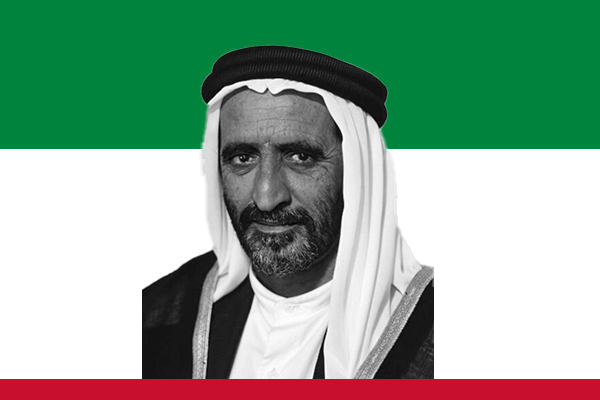
Early Life and Rise to Leadership
Rashid bin Saeed Al Maktoum was born in 1912 into the ruling Al Maktoum family of Dubai. From an early age, he gained practical exposure to governance by observing trade, tribal relations, and maritime commerce that sustained Dubai’s economy. He became Ruler of Dubai in 1958, at a time when the emirate faced financial constraints and lacked modern infrastructure. Rather than accept limitations, he focused on long-term planning, fiscal discipline, and openness to global trade.
Role in the Formation of the UAE
Rashid bin Saeed Al Maktoum played a central role in the creation of the United Arab Emirates in 1971. Alongside Sheikh Zayed bin Sultan Al Nahyan, he helped design a federal system that balanced unity with the autonomy of individual emirates. Upon the establishment of the UAE, Rashid bin Saeed Al Maktoum assumed the office of Vice President, a position he held with consistency and stability for nearly two decades. His leadership supported federal institutions while ensuring Dubai’s interests aligned with national goals.
Vision for Economic Development
As Ruler of Dubai and Vice President, Rashid bin Saeed Al Maktoum championed economic diversification long before oil revenues became dominant. He invested heavily in ports, trade facilities, and infrastructure, believing that commerce and connectivity would secure Dubai’s future. Projects such as the expansion of Dubai Creek and the development of modern port facilities strengthened Dubai’s position as a regional trading hub. His approach emphasized reinvestment, careful borrowing, and confidence in future growth.
Governance and Leadership Style
Rashid bin Saeed Al Maktoum governed with a pragmatic and disciplined style. He valued consultation but expected efficiency and accountability from officials. Known for his frugal personal habits, he insisted that public funds serve development goals rather than short-term display. As Vice President, he contributed to federal decision-making with a focus on economic sustainability, infrastructure coordination, and inter-emirate cooperation.
Contribution to Federal Stability
During the formative years of the UAE, Rashid bin Saeed Al Maktoum helped ensure political stability and institutional continuity. He supported federal policies that strengthened national defense, economic coordination, and international relations. His partnership with the President reinforced unity at a time when the region faced rapid change. This stability allowed the UAE to pursue development without internal disruption.
Legacy and Long-Term Impact
Rashid bin Saeed Al Maktoum passed away in 1990, leaving behind a powerful legacy. His vision laid the foundation for Dubai’s emergence as a global city and for the UAE’s balanced federal system. Many of Dubai’s later achievements grew directly from the infrastructure, policies, and confidence he established. As Vice President, his steady leadership helped transform a young federation into a cohesive and forward-looking nation.
Conclusion
Vice President Rashid bin remains a symbol of strategic foresight and nation-building. His contributions as Vice President of the UAE and Ruler of Dubai shaped economic policy, strengthened federal unity, and set enduring standards for governance. His life reflects how disciplined leadership and long-term vision can transform challenges into national success.