Mr. Theodore Roosevelt
In Office: March 4, 1901 – September 14, 1901
Political Party: Republican
Home State: New York
Lifespan: 1858–1919
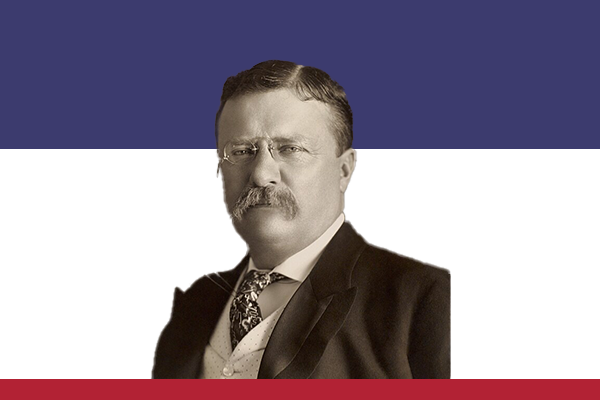
Theodore Roosevelt (1858–1919) was the 25th President of the United States (1901–1909), a statesman, soldier, naturalist, reformer, and one of the most dynamic and influential leaders in American history. Known for his larger-than-life personality, Roosevelt championed progressive reforms, expanded the powers of the presidency, and reshaped America’s role on the world stage.
Early Life and Career
Born on October 27, 1858, in New York City to a wealthy family, Roosevelt suffered from asthma and poor health as a child. Determined to overcome his physical limitations, he embraced a strenuous lifestyle, including boxing, hiking, and horseback riding. He attended Harvard University and later studied law at Columbia, though he left before earning a degree to pursue politics.
Roosevelt was elected to the New York State Assembly at age 23 and quickly gained attention for his energy and reform-minded views. After the deaths of his wife and mother on the same day in 1884, he retreated to the Badlands of North Dakota, where he lived as a rancher and cowboy—an experience that would shape his rugged public persona.
Returning to politics, Roosevelt served in various roles, including Civil Service Commissioner, New York City Police Commissioner, and Assistant Secretary of the Navy. During the Spanish-American War in 1898, he resigned to lead the Rough Riders, a volunteer cavalry unit, and became a national hero after their charge up San Juan Hill in Cuba.
Rise to the Presidency
After the war, Roosevelt was elected Governor of New York and quickly became known for his progressive policies and independence. Republican leaders, hoping to sideline him, nominated him as Vice President under William McKinley in 1900. When McKinley was assassinated in 1901, Roosevelt, at just 42 years old, became the youngest president in U.S. history.
Progressive Reformer
As president, Roosevelt was a driving force behind the Progressive Era. He believed the federal government should be a mediator between capital and labor and actively involved in regulating big business. His “Square Deal” domestic agenda sought fairness for workers, consumers, and businesses alike.
He earned the nickname “trust buster” by taking on monopolies and enforcing the Sherman Antitrust Act. Roosevelt also pushed for food and drug regulation, leading to the Pure Food and Drug Act and the Meat Inspection Act, both passed in 1906.
A passionate conservationist, Roosevelt dramatically expanded the national parks system, creating five national parks, 18 national monuments, and over 150 national forests. He preserved approximately 230 million acres of public land, laying the groundwork for modern environmental policy.
Foreign Policy and Global Impact
Roosevelt believed in a strong, assertive foreign policy summarized by his famous phrase, “Speak softly and carry a big stick.” He strengthened the U.S. Navy and positioned America as an emerging global power. He engineered the construction of the Panama Canal, facilitating global trade and asserting American influence in Latin America. In 1906, he won the Nobel Peace Prize for mediating the end of the Russo-Japanese War—the first American to receive the award.
Later Life and Legacy
Roosevelt declined to run for a third term in 1908, supporting William Howard Taft as his successor. Disappointed with Taft’s more conservative leadership, Roosevelt ran against him in 1912 under the Progressive Party (Bull Moose) banner, splitting the Republican vote and allowing Democrat Woodrow Wilson to win. After the election, Roosevelt remained active in public life, including an ambitious expedition through the Amazon. He died on January 6, 1919, at age 60.
Theodore Roosevelt left an enduring legacy as a transformative leader who redefined the presidency, championed reform, and boldly expanded America’s global role. His energetic style, progressive ideals, and commitment to conservation continue to influence U.S. politics and environmental policy to this day.