Mr. Girija Prasad Koirala
Term 1: 26 May 1991 – 30 November 1994
Term 2: 15 April 1998 – 23 December 1998
Term 3: 22 March 2000 – 26 July 2001
Term 4: 25 April 2006 – 1 April 2007
Political party: Nepali Congress
Home State: Kathmandu
Lifespan: 1924–2010
Image(A-11) credit available here.
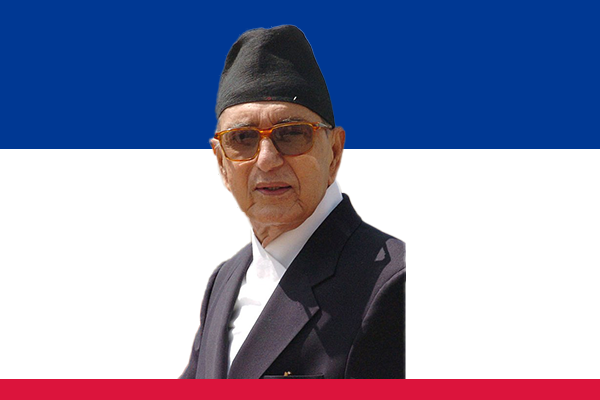
Early Life and Background
Girija Prasad Koirala was born on 20 February 1925 in Saharsa, Bihar, India, to Krishna Prasad Koirala and Divya Koirala. His family belonged to a well-known political household. He grew up in an environment where discussions on democracy and social justice influenced him deeply. His father and elder brothers, especially Bishweshwar Prasad Koirala, inspired him to dedicate his life to politics.
Political Beginnings
Koirala started his political career by actively joining the struggle against the autocratic Rana regime. He worked with the Nepali Congress and took part in several political activities that aimed to establish democracy in Nepal. He involved himself in labor movements and organized workers in Biratnagar, where he emerged as a strong trade union leader. His efforts strengthened the democratic foundation of the Nepali Congress.
Role in Democracy
Throughout his life, Koirala consistently fought for democracy in Nepal. He became the General Secretary of the Nepali Congress in 1976 and later rose to its presidency. He spent years in exile but continued to organize political campaigns to challenge authoritarian rule. In 1990, when the people’s movement against the Panchayat system gained momentum, he played a decisive role in mobilizing support for democracy. His leadership helped restore multi-party democracy in Nepal.
Prime Minister of Nepal
Koirala served as the Prime Minister of Nepal four times: in 1991–1994, 1998–1999, 2000–2001, and 2006–2008. In his first term, he introduced economic reforms and focused on modernizing Nepal’s economy. During his later terms, he concentrated on peace-building and national unity. After the civil war, he facilitated negotiations with the Maoists, which ultimately led to the Comprehensive Peace Agreement in 2006. He worked tirelessly to end the monarchy and guided Nepal toward becoming a federal democratic republic.
Legacy and Death
Koirala earned recognition as one of Nepal’s most influential leaders. He devoted his life to democracy, peace, and national reconciliation. Despite criticism of his political style, he remained a central figure in Nepal’s democratic journey. On 20 March 2010, he passed away in Kathmandu at the age of 86. His contributions left a lasting impact on Nepalese politics.
Conclusion
Girija Prasad Koirala emerged as a symbol of democracy and resilience in Nepal. By dedicating his life to political struggle, he shaped the nation’s transition from monarchy to republic. His leadership continues to inspire future generations of Nepali politicians.