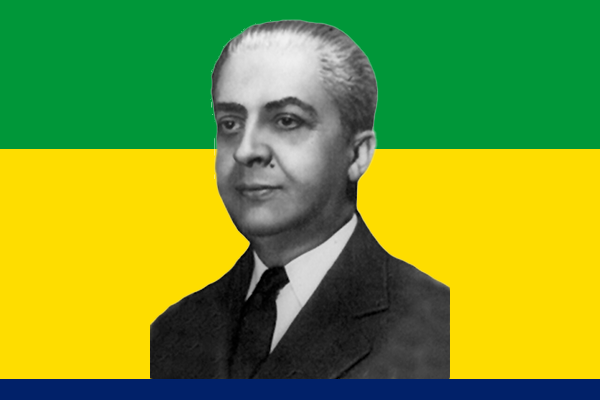
Mr. Carlos Luz
In Office: 8 November 1955 – 11 November 1955
Political Party: Social Progressive Party
Home State: Três Corações
Lifespan: 1894–1961
Country: Brazil
Image credits available here.
Early Life and Political Rise
Carlos Coimbra da Luz was born on August 4, 1894, in Três Corações, Minas Gerais, Brazil. He pursued a career in law and quickly established himself as a respected attorney and public servant. Through his dedication, he entered the political arena, where his integrity and strong principles earned him the trust of his peers. Luz joined the Social Democratic Party (PSD) and built his reputation as a capable legislator with a deep respect for democracy and the rule of law.
As a member of the Chamber of Deputies, Luz actively shaped policies that encouraged national development. He supported education, legal reform, and economic modernization. His leadership and ability to mediate conflicts led to his appointment as President of the Chamber of Deputies, a position that placed him close to the core of Brazilian politics during the 1950s.
Unexpected Path to the Presidency
Carlos Luz became Brazil’s acting president in November 1955 during a time of intense political tension. President Café Filho had temporarily stepped down due to illness, and according to constitutional succession, Luz, as President of the Chamber of Deputies, assumed the presidency.
He took office amid a volatile political environment marked by deep divisions within the military and civil institutions. The presidential election of 1955 had just concluded with Juscelino Kubitschek’s victory, but opposition groups challenged the legitimacy of the results. Luz acted swiftly to protect the constitutional process and ensure a peaceful transfer of power.
He demonstrated firm commitment to democracy and sought to maintain stability by preventing military interference. Instead of yielding to pressure from factions attempting to block Kubitschek’s inauguration, Luz insisted that the election results must be respected. His brief administration thus became a symbol of constitutional loyalty and moral strength.
The November Crisis and Removal from Office
Despite his intentions to safeguard democracy, Carlos Luz faced powerful opposition. On November 11, 1955, elements of the military, led by General Henrique Teixeira Lott, launched a movement known as the “11th of November Movement.” Lott aimed to ensure that Juscelino Kubitschek and João Goulart could assume office as elected president and vice president.
When rumors spread that Luz might align with anti-Kubitschek forces, Lott acted to remove him from power. Luz fled aboard the cruiser Tamandaré, seeking to avoid confrontation, but the Congress declared his presidency vacated. Within days, Nereu Ramos took office as acting president to maintain order until Kubitschek’s inauguration.
Although Luz’s term lasted only from November 8 to November 11, 1955, his actions reflected his unwavering respect for legal authority and national peace. He refused to engage in violence or violate constitutional principles, even when his position was threatened.
Legacy and Historical Significance
Carlos Luz’s brief presidency became a crucial moment in Brazil’s democratic journey. Historians remember him as a man of moderation and integrity who placed the nation’s constitutional order above personal ambition. His calm leadership, even in the face of military pressure, demonstrated his devotion to Brazil’s democratic future.
After his removal, Luz retired from public life but continued to advocate for civic responsibility and political ethics. He passed away on February 9, 1961, leaving behind a legacy of courage and fidelity to democratic ideals.
Though his presidency lasted only three days, it stood as a testament to his belief that democracy must prevail over division and force. In Brazilian history, Carlos Luz remains a figure of moral strength — a leader who chose the law over power and peace over conflict.